
20 May 26
On New Music
Microtonality is having a moment. I am late to this trend, but two days ago I discovered the Québécois rock band duo Angine de Poitrine who is now all over the internet. Back in February, the Seattle radio station KEXP posted a YouTube video of a set the band did at a music festival in Rennes, France in December. This video rapidly went viral, and as of this writing has 14.8 million views on YouTube. Clearly the band has tapped into something in the public’s consciousness, but what?
The first thing one notices on the video are the Dadaesque costumes — masked figures in black and white polkadots with especially long noses. The conceit is that they are alien timetravellers, brothers named Khn and Klek de Poitrine. Klek is the drummer, and Khn plays a double-necked combination bass and guitar. Look closely at the bass-guitar combo and one will notice rather a lot of frets on the two necks.
The costumes may be what draw people to look at the band, but the music is what is compelling and new. The reason for the large number of frets is that it is a microtonal instrument, and the frets are spaced in quarter tones. The band plays microtonal math rock, the latter meaning there are a lot of complex time signatures and polyrhythms. And the two musicians are really good: they have been playing together since they were teenagers. Khn uses a live looper to layer different bass and guitar lines together in sequence, which seems like quite a feat of hand-foot-toe coordination. Despite the complexity of the music, it remains accessible with a strong groove.
Commentary on the band is its own subgenre on YouTube. Some of this commentary goes into music theory: there are videos looking at the microtonality, and other videos analyzing the polyrhythms. There is other discussion about why this band has gone viral. One thread that comes up a lot is that the band has put things together in a way that could not have been done by AI. Despite being alien timetravelers, what they have done is a profound act of human creativity.
25 April 26
The Tyranny of The Work
Western classical music is a really strange thing when one takes a broad enough view of it. There is no other musical tradition that I am aware of that insists upon fidelity to a strict written score, and eschews improvisation in the whole. A couple days I ran across an English musicologist named Daniel Leech-Wilkinson who has battled the implications of this strangeness. He has recently put together an open-access ebook entitled Challenging Performance that lays out his contentions. To quote from him
Why is it so important now to start to perform classical scores differently? In sum:
Because to believe that there is broadly one correct way to perform a classical score is mistaken ethically, historically, and factually.
Because the policing of conformity by gatekeepers that is required to enforce this mistake—to prevent it being noticed, exposed and challenged—denies performers full credit for their arguably equal contribution (with composers) and a just financial reward for their contribution; and denies them the right and ability to be innovative or even significantly creative.
Leech-Wilkinson has a background in studying medieval music, where one by necessity has to be creative with interpretations — there is extremely little information to rely upon in the musical notations we do have from the medieval period. I noticed that he wrote a book published in 2002 entitled The Modern Invention of Medieval Music: Scholarship, Ideology, Performance and immediately wanted to read it. Happily, I have access to an efficient interlibrary loan service and a copy of the book arrived for me via ILL late this afternoon!
20 April 26
Ad Mortem Festinamus
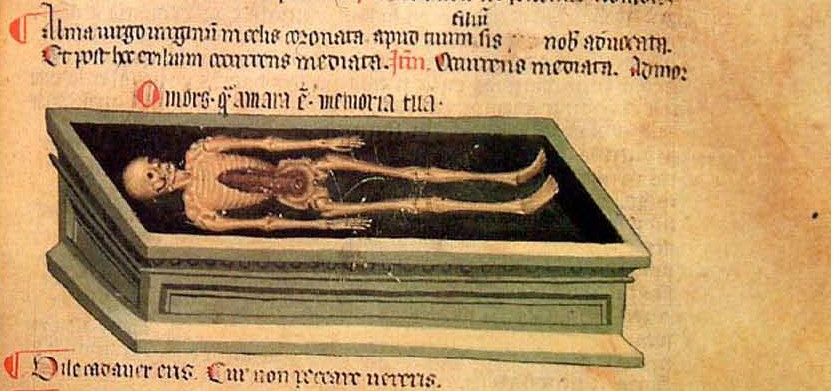 A wonderful music book just arrived for me containing 105 medieval melodies scored for alto recorder which I am now starting to learn. A lot of these songs are familiar to me but it is good to have such a compilation. I’m practicing the song Ad Mortem Festinamus which is this delightfully bouncy tune that belies the topic of its lyrics, all about us hastening unto death so we had better stop sinning. It has been recorded fairly often; here is a live performance by Jordi Savall and Hespèrion XXI.
The lyrics and the melody for Ad Mortem Festinamus are contained in the Llibre Vermell de Montserrat, a manuscript that was compiled at and still resides in the monastery at Montserrat. This manuscript contains nine other songs with musical notation. The illumination at left is from the second page of the text and music for the song.
15 April 26
Beethoventown
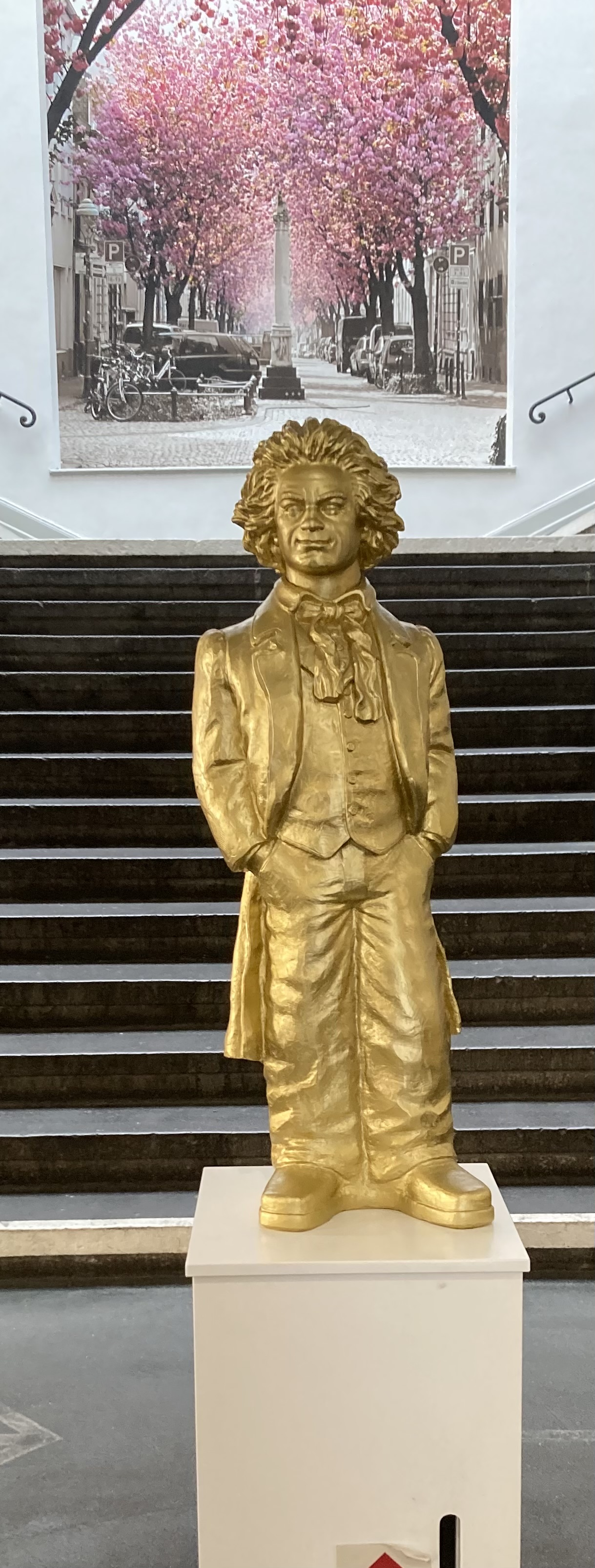 Bonn isn’t about to let any visitor leave without knowing that its most famous son, the composer Ludwig von Beethoven, was born here. There is obviously the Beethovenhaus which I visited today. There is a Beethovenstrasse, a Beethovenhalle, a Beethoven Gymnasium, a Beethoven Park. Shop windows of everything from Apothecaries and Antiquarians to Restaurants and Tobacconists feature his bust, his statue, or the modified smirking one at right, complete with falling-down trousers; a copy of this sits opposite me in the garden of the basement flat where I’m typing.
What impressed me about the museum visit was just how many images had been made of this composer, in an early nineteenth-century masterclass in image curation. Multiple busts, drawings, paintings, but also his correspondence with adoring literary admirers, who stoked the fire of his burgeoning fame.
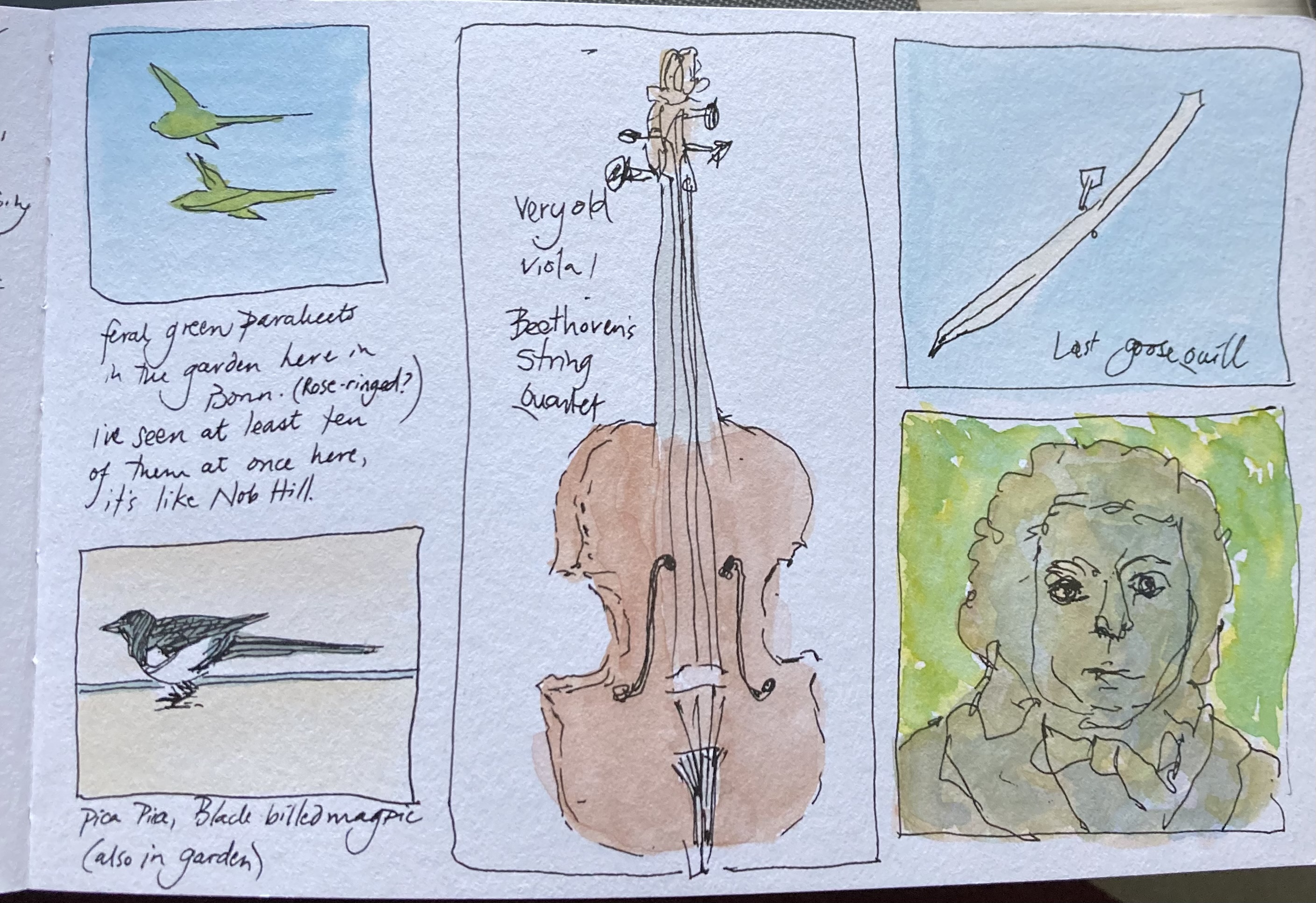
I was especially entranced by Beethoven’s “last quill” — as you see below, there are no annoying feathers that seem de rigueur in period films but which get in your nose and are quite impractical, as well as being irresistible to moths. Beethoven’s quill was able to hold a fine line and live up to multiple parings, and his working and re-working of pieces was displayed in a pentimento-style buildup. (It reminded me of how Numenius and I first met online over 30 years ago now, a conversation about goose quill knives for calligraphic purposes.) Beethoven’s goose was almost certainly a greylag, which are ubiquitous along the Rhine. Of special interest to me is the length of the central slit, much longer than I was taught to cut, but if might also be damage from a later time; 200 years is an astonishing length of time for a quill to survive, assuming they’re not fibbing about it.
I leave this lovely cherry-blossomed city tomorrow for the UK and friends and relatives. I’m not sure if I’ve been able to do as much chatting with strangers as I’d hoped, but with bronchitis having walloped me, I think it’s okay.
9 March 26
For Fun Or For Beauty?
Thanks to a link on MetaFilter, recently I watched a masterful long-form video by jazz bassist and YouTuber Adam Neely entitled “Suno, AI Music, and the Bad Future”. Suno is the technology company that has become the biggest powerhouse in AI music. A usual workflow with Suno is to give it some text prompts describing the characteristics of the music you want and perhaps some lyrics and then Suno will take that and generate a fully instrumented song for you.
Needless to say, Neely is not a fan.
Commercial generative AI is bad in ways which are different from other disruptive music technologies of the past, like MIDI sequencing and samplers, because there is a sociopolitical agenda behind its adoption. This agenda will be bad for musicians, it will be bad for music lovers, and it will leave us feeling more alienated and alone…Like any culture war, it’s a distraction from the real war, the class war. You see, there is a class of techno-capitalists who are currently using generative AI as a means of wealth extraction. They do this by circumventing intellectual property laws…
Fifty-nine minutes into the video, Neely links AI music to technofuturist movements past and present. He discusses the Italian futurists, in particular Filippo Marinetti who in 1909 pens The Futurist Manifesto. Nine years later he goes on to write the original Fascist Manifesto. Today’s technocapitalists such as Marc Andreessen view Marinetti as a patron saint. Theirs is the same worldview that produces abominations such as Reflect Orbital’s plan.
Suno describes their core values as being “Music, Impatience, Aesthetics, and Fun”. Neely would replace these values with Service, Patience, Craft, and Beauty.
Neely believes generative AI will cause music to split into two different art forms, just as theatre and cinema are different but related art forms. These will be live and recorded music, and he has a lot of hope for the future of live music.
10 November 25
50 Years Ago Today
… A freighter carrying iron ore was sunk on Lake Superior in hurricane-force winds.
I don’t follow the shipping news and even if I had I’d never have heard of this particular tragedy if it weren’t for a song by Gordon Lightfoot, the Canadian musician who died in 2023. The Wreck of the Edmund Fitzgerald is a masterpiece of storytelling and melody.
Every year the Mariners’ Church in Detroit tolled its bells 29 times to commemorate the lives lost on the freighter. After Lightfoot died they changed it to 30.
How we as humans choose to memorialize our dead is an interesting question I’m pondering as I’m planning a trip to Bodega Bay tomorrow to have my own memorialization of my parents…
9 November 25
House of the Perpetually Setting Sun
Pica has been subscribing to Netflix for the past few weeks mainly to watch the new season of “The Great British Bakeoff”, and yesterday I took advantage of the access to view the new movie directed by Kathryn Bigelow, “A House of Dynamite”. This is a nuclear war thriller about the response of the United States government to the detection of a single ICBM of unknown origin on a suborbital trajectory leaving the Pacific to strike the continental U.S. This covers a period of about 18 minutes between detection and impact, which makes for a quite short movie in real time. Bigelow’s intent in the movie is to show the reactions of the key people involved in the crisis, and she accomplishes this by following different sets of people in three different retellings of the 18 minutes. The first part follows the duty officer in the White House Situation Room (played by Rebecca Ferguson) as well as the crew of the anti-ballistic missile base in Alaska trying to shoot down the ICBM. The last part focuses on the response of the President of the United States, played by Idris Elba. Narratively I didn’t find that this structuring of the story worked well. The first portion was quite exciting, but in passes 2 and 3 it grew tedious. The strongest performance in the movie was from Rebecca Ferguson, but her story ended in the first portion.
The movie was good, not great, more didactic than memorable cinema. We certainly learn about the impossibility of communication among decision-makers under a crisis of such a short timespan, and the doubtful utility of the present-day anti-ballistic missile system (“hitting a bullet with a bullet” is the phrase they use in the movie). My favorite movie in the genre of nuclear war films still remains “Dr. Strangelove”.
29 October 25
A Visit to Berkeley
I took myself to Berkeley yesterday to visit my mother-in-law whom I love but don’t see very often. She had recently had a heart procedure but wanted to give me a hug in person following mum’s death.
I don’t see her very often, but I almost NEVER see her alone. Our conversation ranged far and wide — I told her about alchemy and what I’d been reading, we talked about music and its relation to poetry. I have always wondered whether composition is like poetry, in that it seems to fall out of the sky. Well, yes, she said, but there are rules.
I have never listened to much Schubert outside of the Lieder but she pointed me to his final piano sonata (D960 in Bb major). Sharon says he was the master of juxtaposition: in one bar your dog died, in the next, you’re eating cotton candy. I listened to this sonata after I got home and it really does plumb the depths of grief, so I think I’ll be listening to it some more. When she told me that Numenius’ father had asked for it to be played during his last 24 hours of life, it made me determined to listen to it even more carefully.
Write a book, she said. Write a book about your mother, since it’s really hot now. Even if only 10 people read it. Hot like an alchemist’s flame? It’s a thought.
6 October 25
Jazz Band
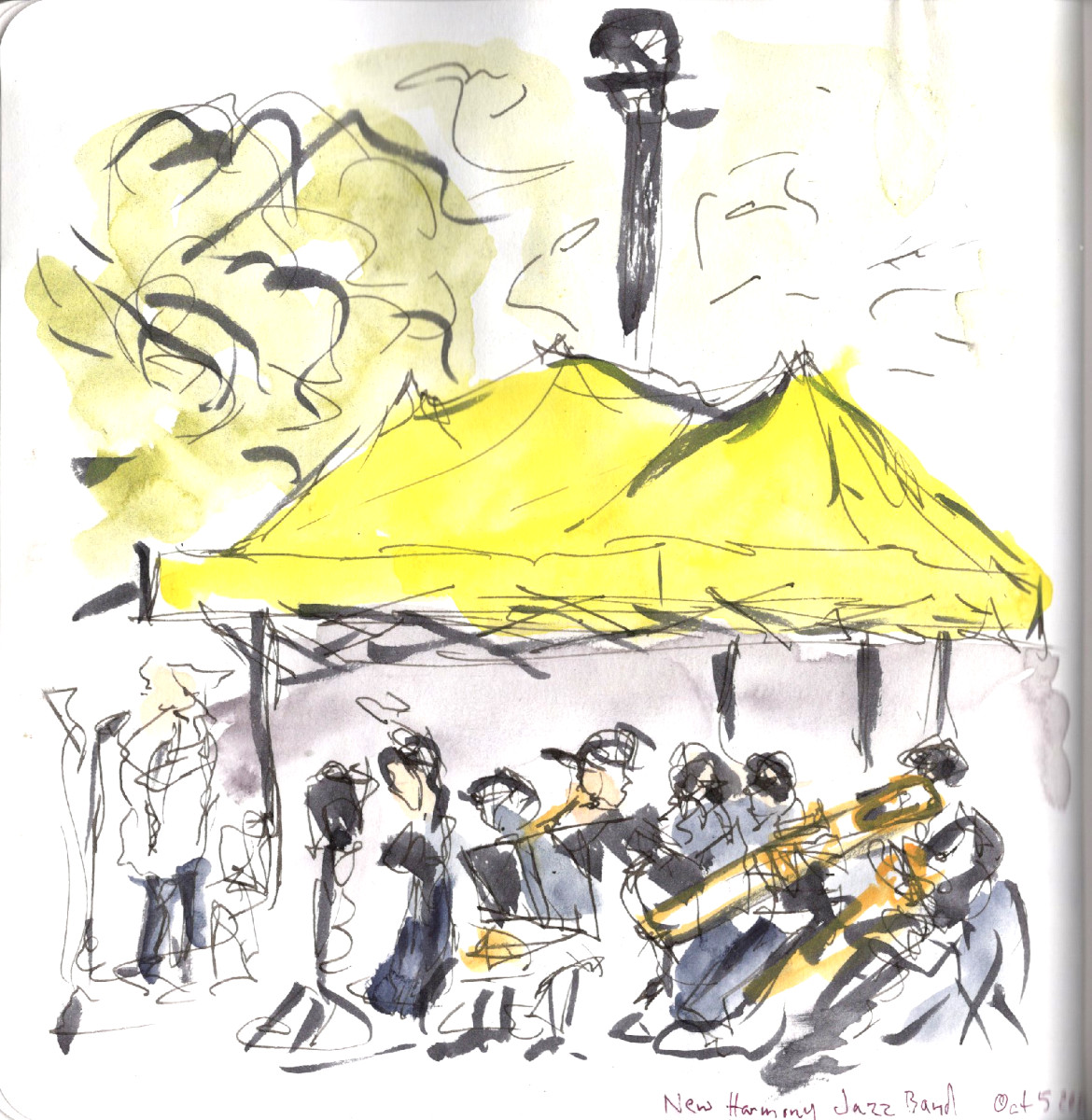 This is my urban sketch for this past Sunday. I went over to Central Park where the biweekly Davis Craft & Vintage Fair was taking place. The local New Harmony Jazz Band was playing at one end of the fair, as they often do.
I am getting used to sketching in this 7”×7” sketchbook. It’s a little bigger than what I’ve been sketching in previously, but this lets me be freer with the sketches. I like the combination of fountain pen fine line work with a gray Pentel brush for bolder ink strokes. I am still pleased with the Derwent line and wash kit. It was nice to have that bold Inktense yellow handy for the tent canopy. And I figured out how to mix skin tones with the paint pan set: I used a combination of poppy red with the mango Inktense colors.
28 July 25
The Monk Of Santa Cruz
I was saddened to learn yesterday of the death a couple days ago of the satirical songwriter and performer Tom Lehrer at age 97. By coincidence I was watching an interview yesterday with the creator of the website hosting all of Tom Lehrer’s works. The interview was from three weeks ago, when Tom was very much alive. The interview prompted me to check his entry in Wikipedia and I was taken aback to learn he died the previous day.
Tom Lehrer’s songs were very much a part of my childhood in the early 1970s. I don’t know if it was my record-collecting father or my record-collecting brother who brought the recordings home, but I heard his songs often. Judging from the accolades these past couple of days, many other people loved his songs as well.
He withdrew from songwriting and performing in the late 1960s, but his satire remains surprisingly relevant in 2025. The flip side of this is the unfortunate truth that we really haven’t solved any of these issues since then! (E.g. his song “Who’s next” is all about nuclear proliferation.) Starting in 1972 he settled into a quiet career teaching mathematics for non-majors and musical theatre at the University of California, Santa Cruz.
Here is a just-posted musical eulogy for Tom Lehrer by the interviewer referred to above, Kira Coviello (aka Honest2Betsy).