
Wednesday September 16, 2026
Contour Carrots
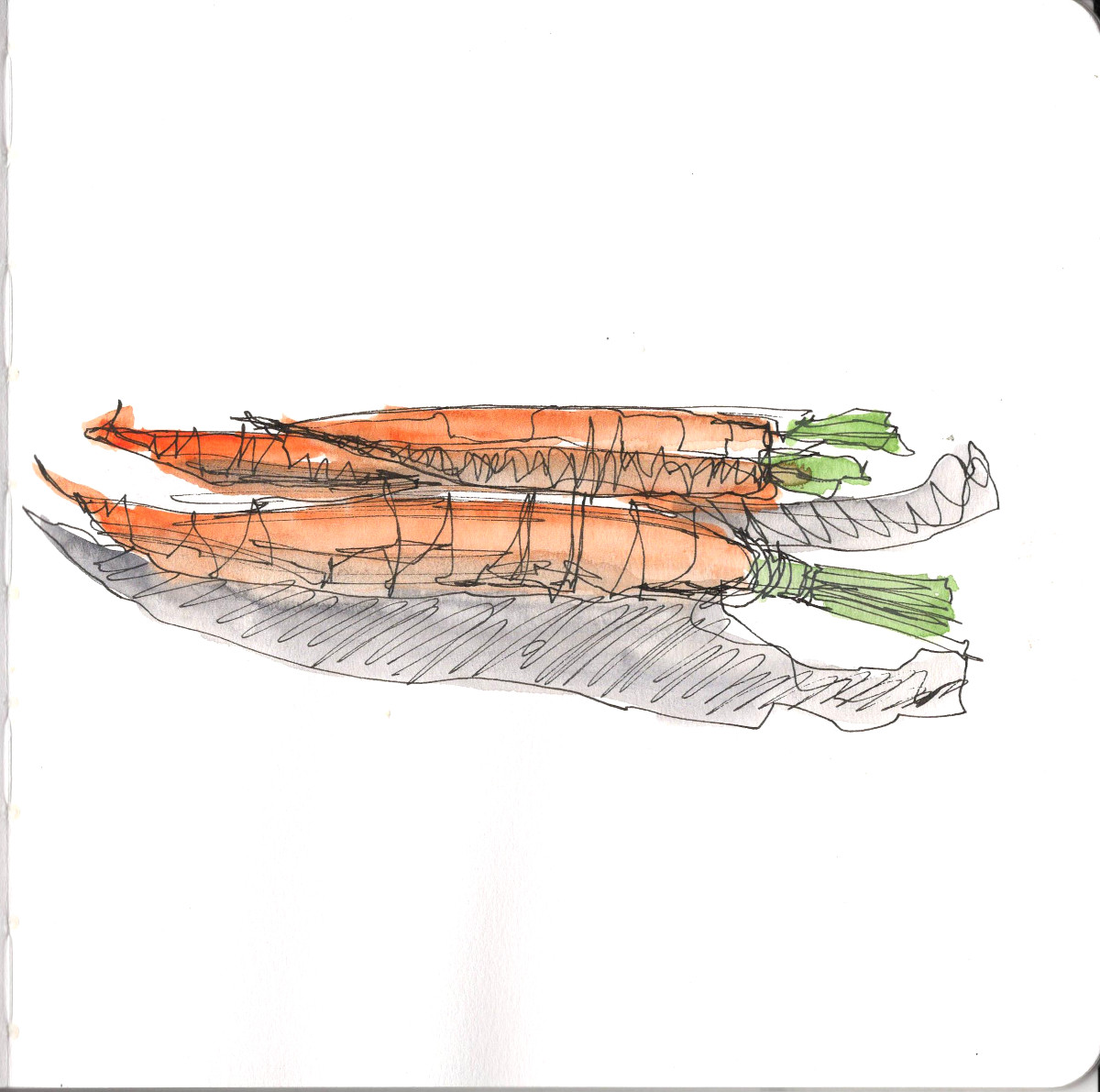 Yesterday I joined Pica in watching Maria Coryell-Martin’s class on ink and watercolor for the Wild Wonder Conference. Maria’s philosophy is that ink gives the bones to a sketch, and watercolor brings it to life. One of the techniques she presented was beginning with a contour sketch of the subject in waterproof ink followed by adding watercolor. I tried this today with three carrots.
Tuesday September 15, 2026
Wild Wondering
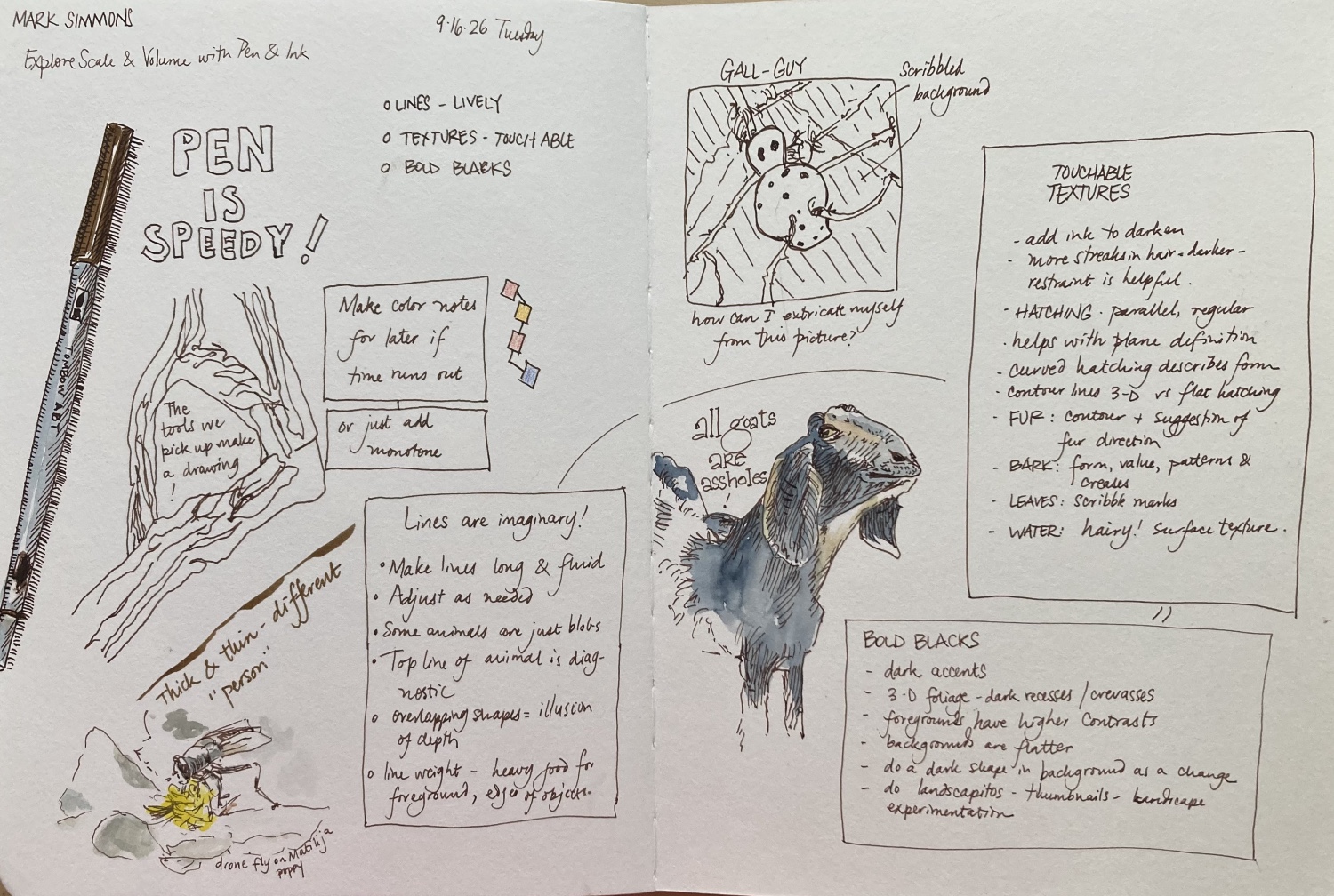 I’ve attended four zoom presentations today at the Wild Wonder Conference, all of them excellent, but I’m exhausted now. This one was the first, when I was still fresh at 8:30 this morning.
All goats are obnoxious even when they’re pretending to be friendly…
ETA: It was five, not four, zoom presentations, though I snuck out for a coffee during one of them.
Monday September 14, 2026
Circular Tug-of-War
I just finished reading The Messi Effect: How the Global Legend Changed the Future of American Soccer by Paul Tenorio. This is a look at the impact of the arrival of Lionel Messi at the Major League Soccer (MLS) club Inter Miami CF in July 2023. Inter Miami is a pretty new expansion club, having played its first match in February 2020. Inter Miami’s owners talked the legendary player into joining their club after a stint at Paris-Saint Germain, and his arrival catapulted their club into the stratosphere. Inter Miami Messi jerseys outsold all others for a while. Every match the club played was packed with fans wanting to see the superstar.
MLS true to form didn’t and doesn’t know what to make of all this. They modelled their ownership structure on the National Football League (NFL), with their commissioner for the past 27 years, Don Garber, having previously been an NFL executive. Competitive balance among teams has been an important principle for MLS, as is the case in NFL. Basically my impression of MLS is that it doesn’t know which way it wants to go, or rather the thirty different ownership groups are tugging in different directions. The arrival of Messi was one watershed moment in the history of the league. The 2026 World Cup being held in the United States was another watershed moment. Can the league take advantage of the attention that soccer has gotten here this past summer? Things move slowly with MLS, and nothing will change until at least 2027. The first big change will be aligning the MLS season with the late summer to late spring schedule of most other leagues globally, so as to participate more easily in other leagues’ transfer window markets.
Sunday September 13, 2026
Learning to Love Cauliflouring in Watercolor
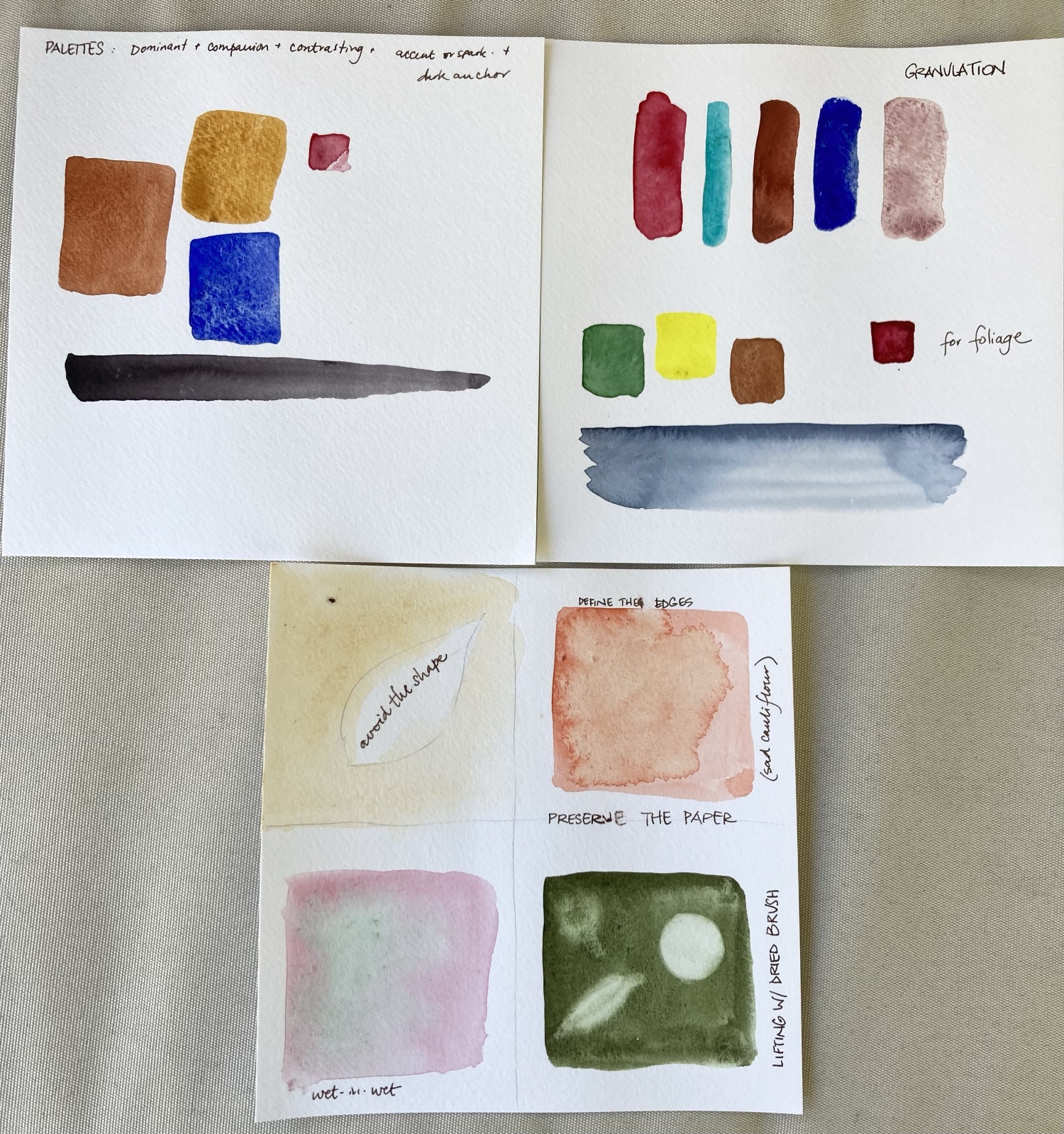
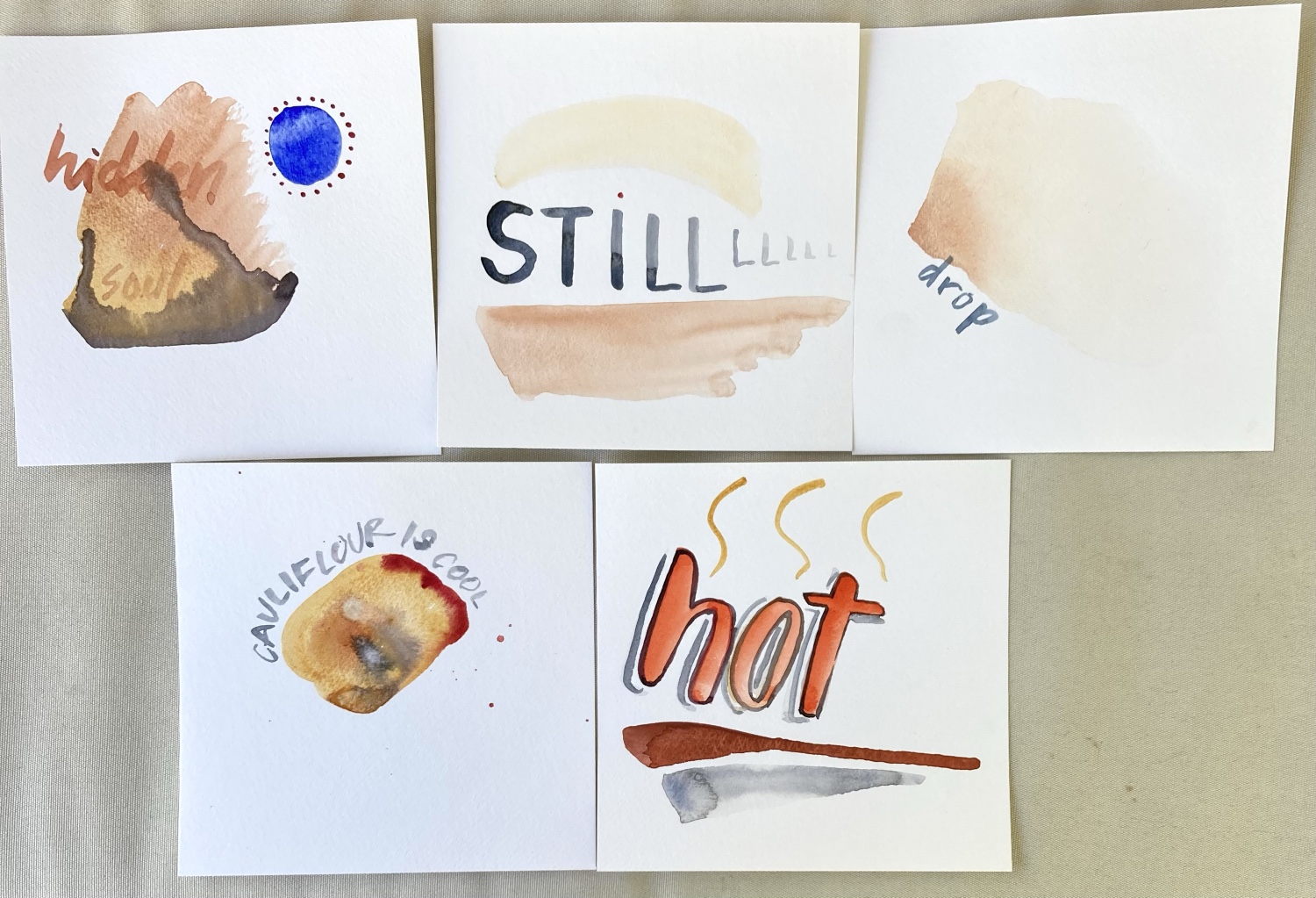 As I mentioned, I had a workshop yesterday about losing our fear of watercolor. We were encouraged to take five colors to make one or more palettes, seen in the first photo. We made different saturations of the same color. Then we lettered with a round brush, and experimented with adding outlines with ink or brush.
It was a great experiment and I will be doing more playing in the Stillman and Birn Zeta sketchbook that arrived in the mail today.
Watercolor purists spend a lot of time and energy trying to avoid the effect known as cauliflouring: mostly this happens because impatient painters apply wet paint to almost-dry paint. I’m trying to learn to work with the effect, since patience isn’t a strong suit of mine.
Saturday September 12, 2026
Freeform Radio Sketch
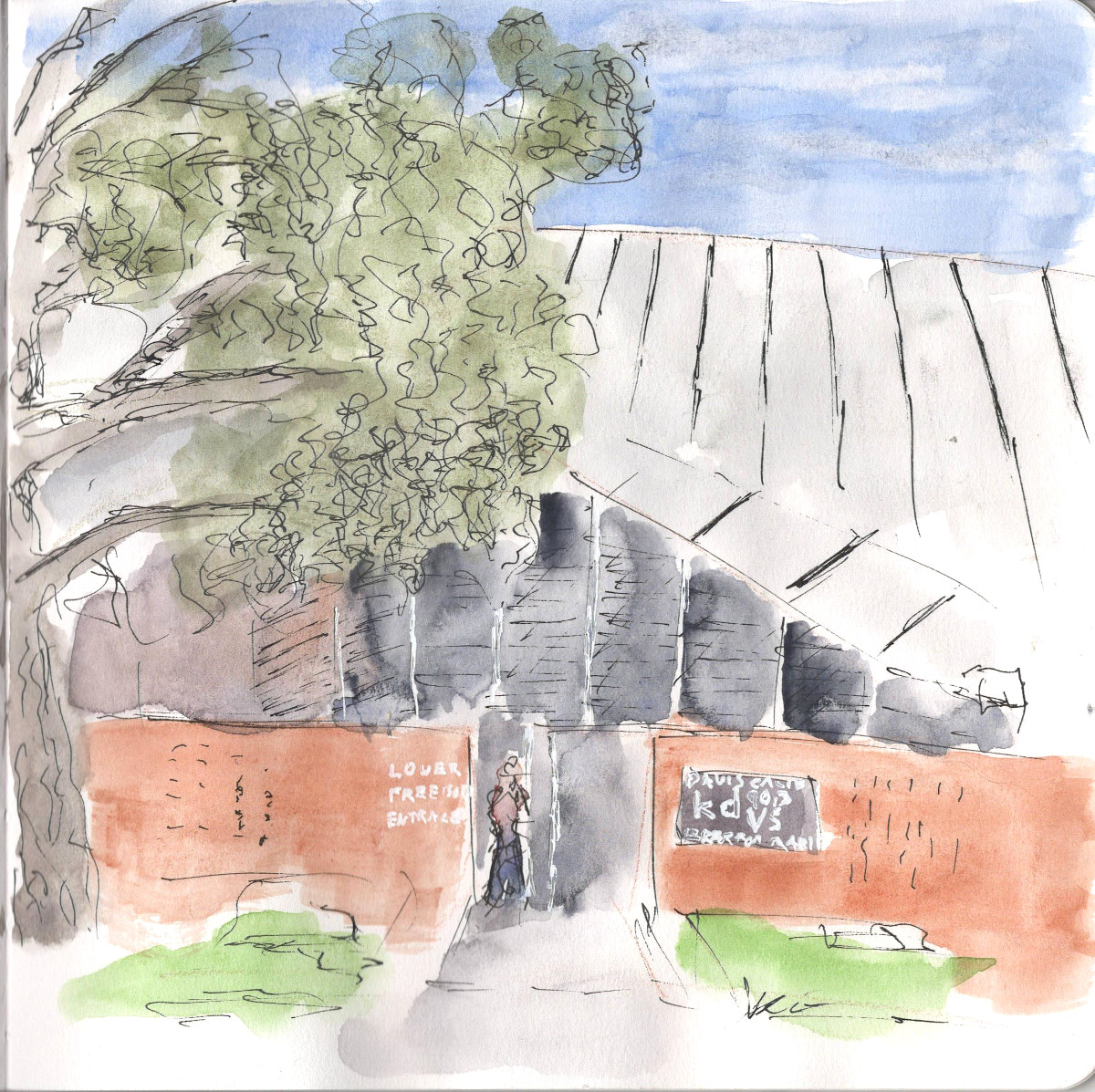 I went over to campus this morning to do my urban sketch for the day and found myself sitting across from the entrance to the KDVS studio in Freeborn Hall. KDVS is the college radio station here, broadcasting at a power of 13,000 watts from an 194’ tall antenna located near the Yolo County Landfill northeast of Davis. Their tagline is “Freeform Community Radio”, which is par for the course for a college radio station.
Friday September 11, 2026
Watercolor for Haters
 I have a definite comfort zone when it comes to sketching: I sketch in fountain pen with waterproof ink, then I add watercolor. But I’m not a watercolor artist. It’s a fiendishly difficult medium and I have a tremendous amount of admiration for people who do it well.
Tomorrow I’m taking a class called Watercolor for Haters. I am looking forward to fun and sloshing water and paint around. I can’t wait.
Thursday September 10, 2026
Cloudsurfing
 I was walking downtown this evening, looked to the west, and saw a nice wave cloud — I think this is an example of a Kelvin-Helmholtz cloud. It was a really hot day but there have been scattered clouds all day. The wave pattern seemed to dissipate pretty quickly. Looking at an animation of satellite imagery at the time of the photograph it seemed like there was a lower air mass moving to the south and an upper level air mass moving to the east, which could set up the wind shear needed to form this wave pattern.
Wednesday September 9, 2026
Vuelta a España
The Vuelta, the final of the three grand cycling tours of the year, is in the middle of the final week. I’ve been following it more or less daily, watching the stage on Peacock with commentators Bob Rohl and Christian Vande Velde, both of whom were professional cyclists. (I also sometimes catch the post-race commentary on the Lanterne Rouge Cycling Podcast where an Australian and a Belgian offer a wry but very knowledgeable take on the day’s events.)
We picked up a Peacock subscription in order to watch the World Cup, because they were streaming commentary in Spanish. We’ve held onto it in order to watch Premier League matches, but I’m enjoying the Vuelta as a side early-morning entertainment. The cyclists are, as I write this, heading into Sevilla after an almost completely flat stage. A dangerous bunch sprint is expected.
I’d really rather follow cycling in the broadcasts of the countries where they’re taking place, especially since Bob Rohl, a somewhat goofy, good-natured big guy (for a cyclist) really needs to work on his geography. (The Guadalquivir drains into the Atlantic, not the Mediterranean, Bob.) And then I remember that this kind of snark about Spanish geography is what got me kicked out of geography class in boarding school without enough guts to join the German class three weeks into the term. The monkey on my back all these decades later is what set me off on the German-learning kick…
Tuesday September 8, 2026
Computer In Drydock
One of the motivations for building one’s own computer is that if something goes wrong with it one should be able to repair it. Alas, I am putting this to the test right now. After booting perfectly for 13 months, the workstation that I built in May 2025 started having trouble booting. At first this wasn’t a big deal — I would just power it up several times and it would boot. Watching the POST (power-on self test) LED indicators it was clear this problem was hardware related — the boot failure was occurring before the computer loaded in the operating system code. Just before we left for Spain, the computer changed from booting after several times to only booting once in a blue moon.
After reading up on POST failures and testing all the components I could think I concluded by elimination the computer has a motherboard problem. The good news is that the motherboard is the least expensive electronic component in the system (the extraordinary increase in the price of memory is part of that) and that it is still under warranty; the bad news is that the computer needs to be taken mostly apart to remove the motherboard so it can be shipped off. I spent yesterday afternoon dissecting my computer and today I went to the shipping store downtown to send the motherboard off to the manufacturer (total shipping cost $24). We will see if this leads to a working computer in a couple of weeks. These are very bad times for the PC building hobby, all part of the enclosure movement occurring all across information technology.
Monday September 7, 2026
Disposition of Stuff
It’s been almost a year since Mum died, and watching this video by estate seller Walter Ashford, about how to dispose of things before you go, it looks like she did it almost perfectly. I remember the hours we spent with her last year, going through old photographs. She had already, long before, given old family photos to me, naming the people she knew and telling me “oh, that was a friend of Helen’s, I never knew her name,” which was a perfect reason to toss it. She had given me her signed copy of Auden’s poetry, she had sorted out the Rosenthal china (mostly) with my sister, she had sold the silver nobody was ever going to want. My sister has the hand-embroidered linens. But the best thing is, we got to say, while she was still alive, what we wanted to keep. There was no fighting about it. All this is very much in line with Margareta Magnusson’s Gentle Art of Swedish Death Cleaning, where you carefully dispose of all your crap before you die so your children don’t have to. Ashford says that what kids want to keep is often a surprise.
I don’t have children, and my niece and nephew are unlikely to want anything of mine, but I do think the advice in the video is very useful for people contemplating downsizing:
a) Ask your heirs, independently, what one thing in your house would be upsetting to them if they found out it had gone. Write it down.
b) Write down in pencil on the backs of photos who the people are and the date. You’re often the last person who can do this.
c) Break sets on purpose. Nobody is going to want a full 12-place dinner set, but 6 silver teaspoons? (Don’t give your children the burden of disposing of your stuff they took out of guilt.)
d) If there really are things in your house that are valuable or that might be, get them appraised before your death.