16 September 26
Contour Carrots
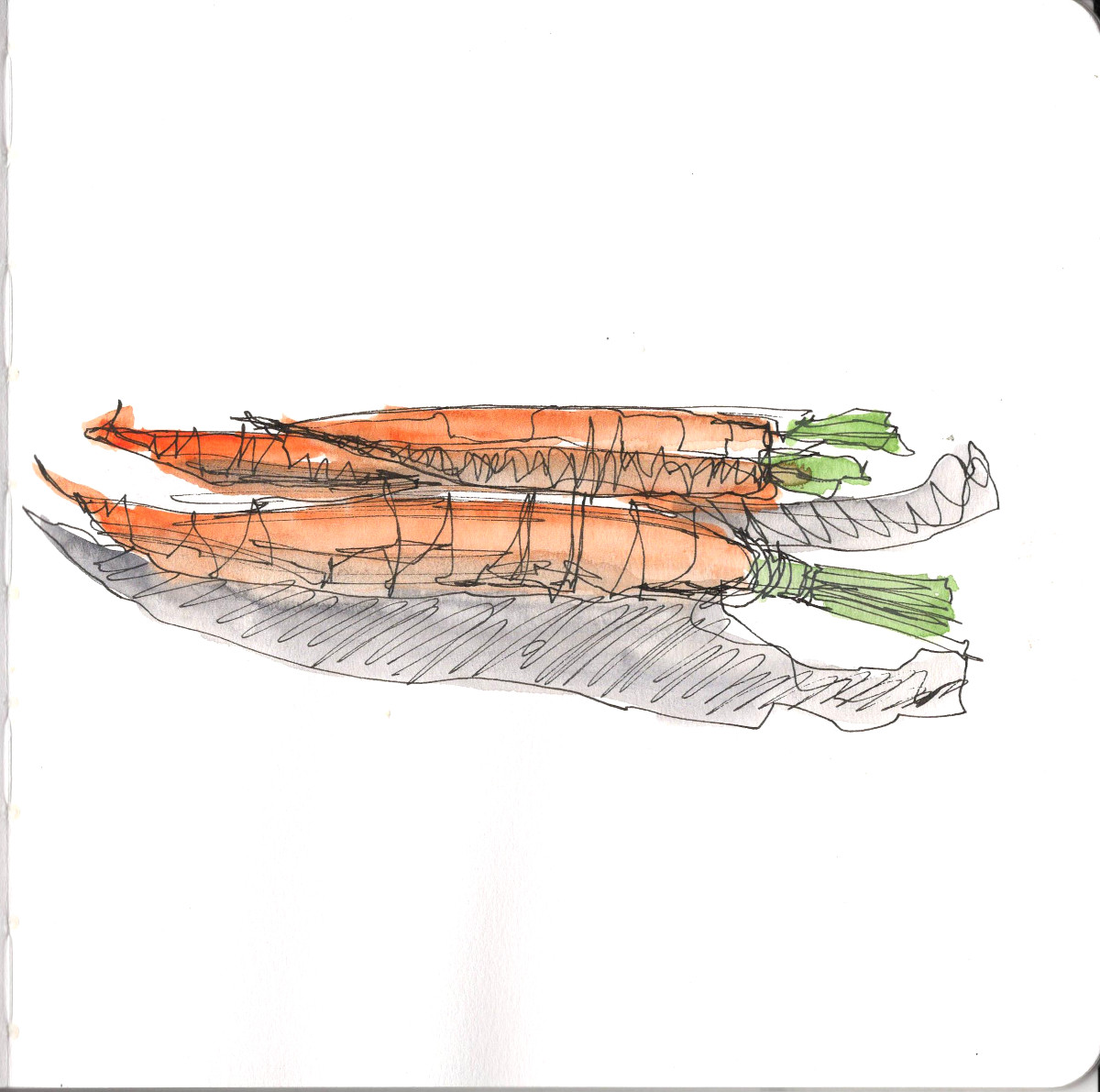 Yesterday I joined Pica in watching Maria Coryell-Martin’s class on ink and watercolor for the Wild Wonder Conference. Maria’s philosophy is that ink gives the bones to a sketch, and watercolor brings it to life. One of the techniques she presented was beginning with a contour sketch of the subject in waterproof ink followed by adding watercolor. I tried this today with three carrots.
15 September 26
Wild Wondering
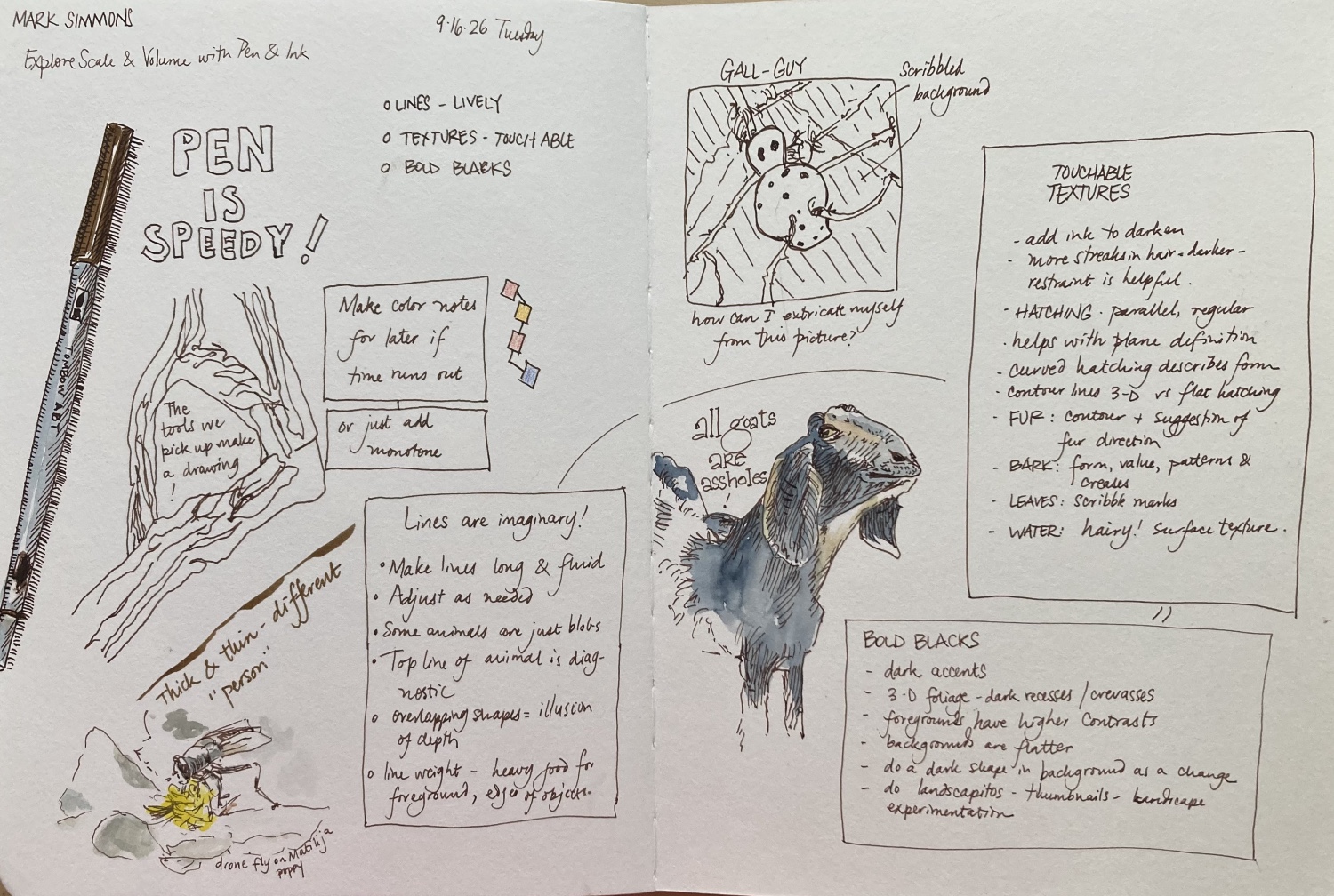 I’ve attended four zoom presentations today at the Wild Wonder Conference, all of them excellent, but I’m exhausted now. This one was the first, when I was still fresh at 8:30 this morning.
All goats are obnoxious even when they’re pretending to be friendly…
ETA: It was five, not four, zoom presentations, though I snuck out for a coffee during one of them.
13 September 26
Learning to Love Cauliflouring in Watercolor
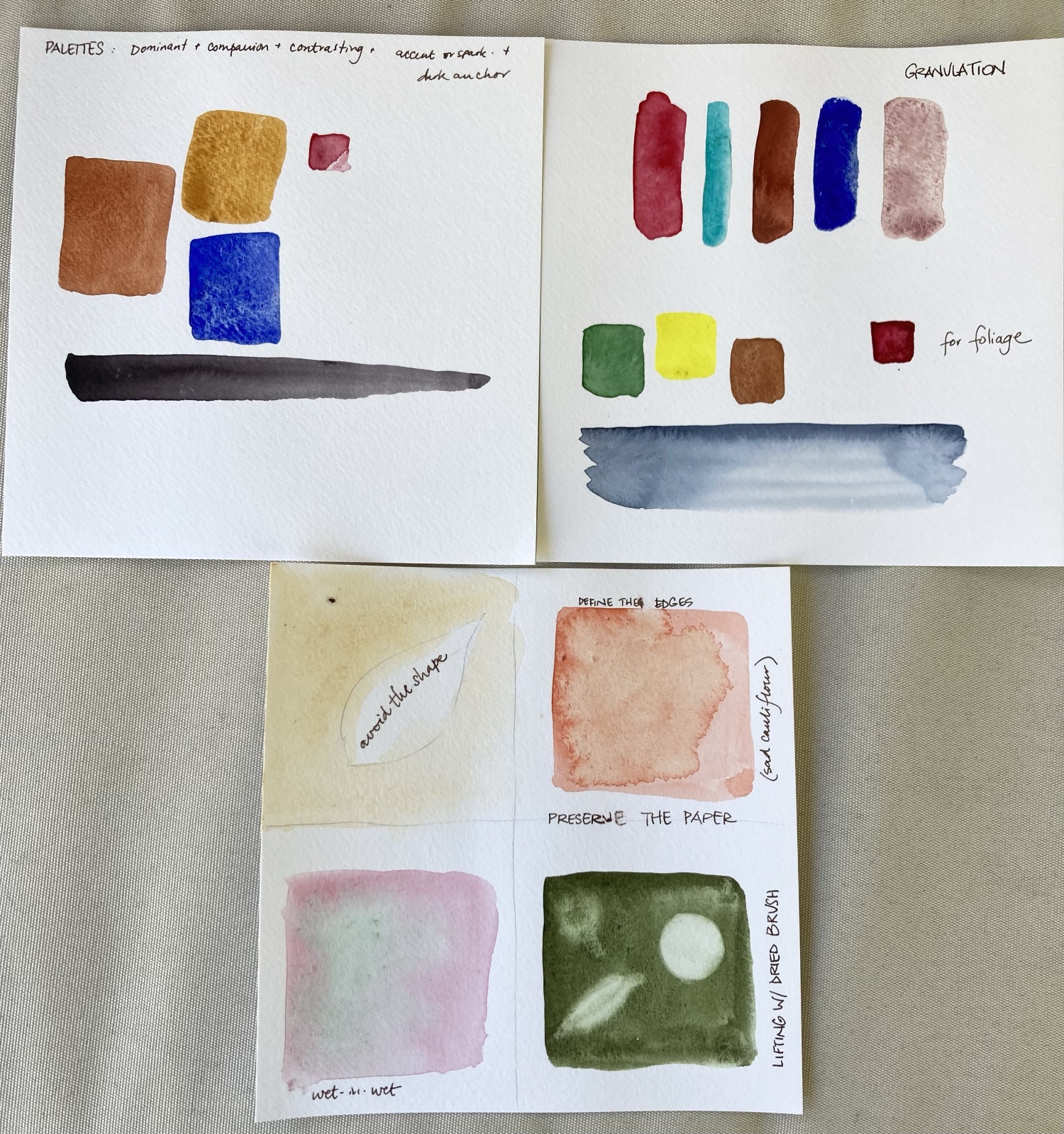
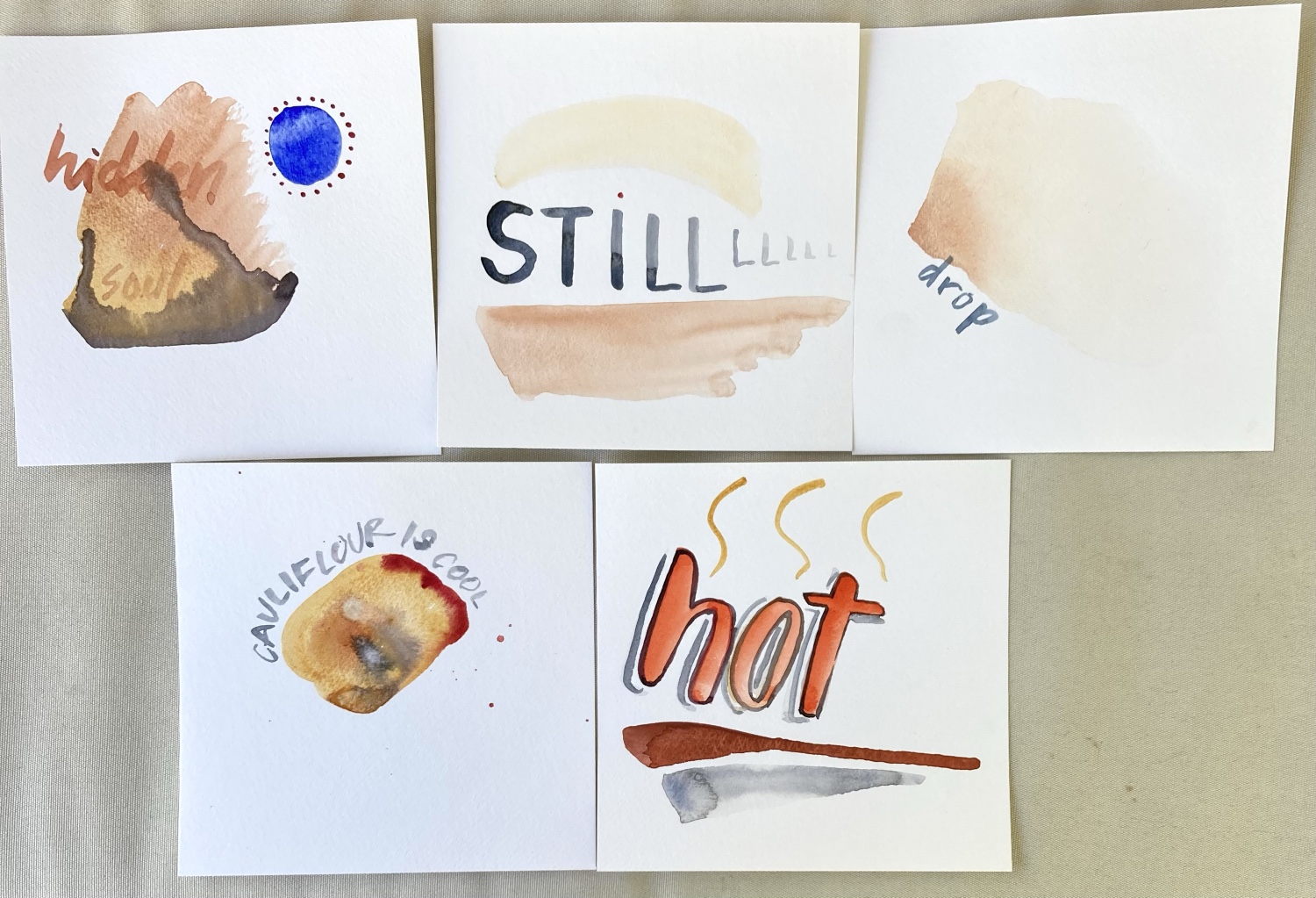 As I mentioned, I had a workshop yesterday about losing our fear of watercolor. We were encouraged to take five colors to make one or more palettes, seen in the first photo. We made different saturations of the same color. Then we lettered with a round brush, and experimented with adding outlines with ink or brush.
It was a great experiment and I will be doing more playing in the Stillman and Birn Zeta sketchbook that arrived in the mail today.
Watercolor purists spend a lot of time and energy trying to avoid the effect known as cauliflouring: mostly this happens because impatient painters apply wet paint to almost-dry paint. I’m trying to learn to work with the effect, since patience isn’t a strong suit of mine.
12 September 26
Freeform Radio Sketch
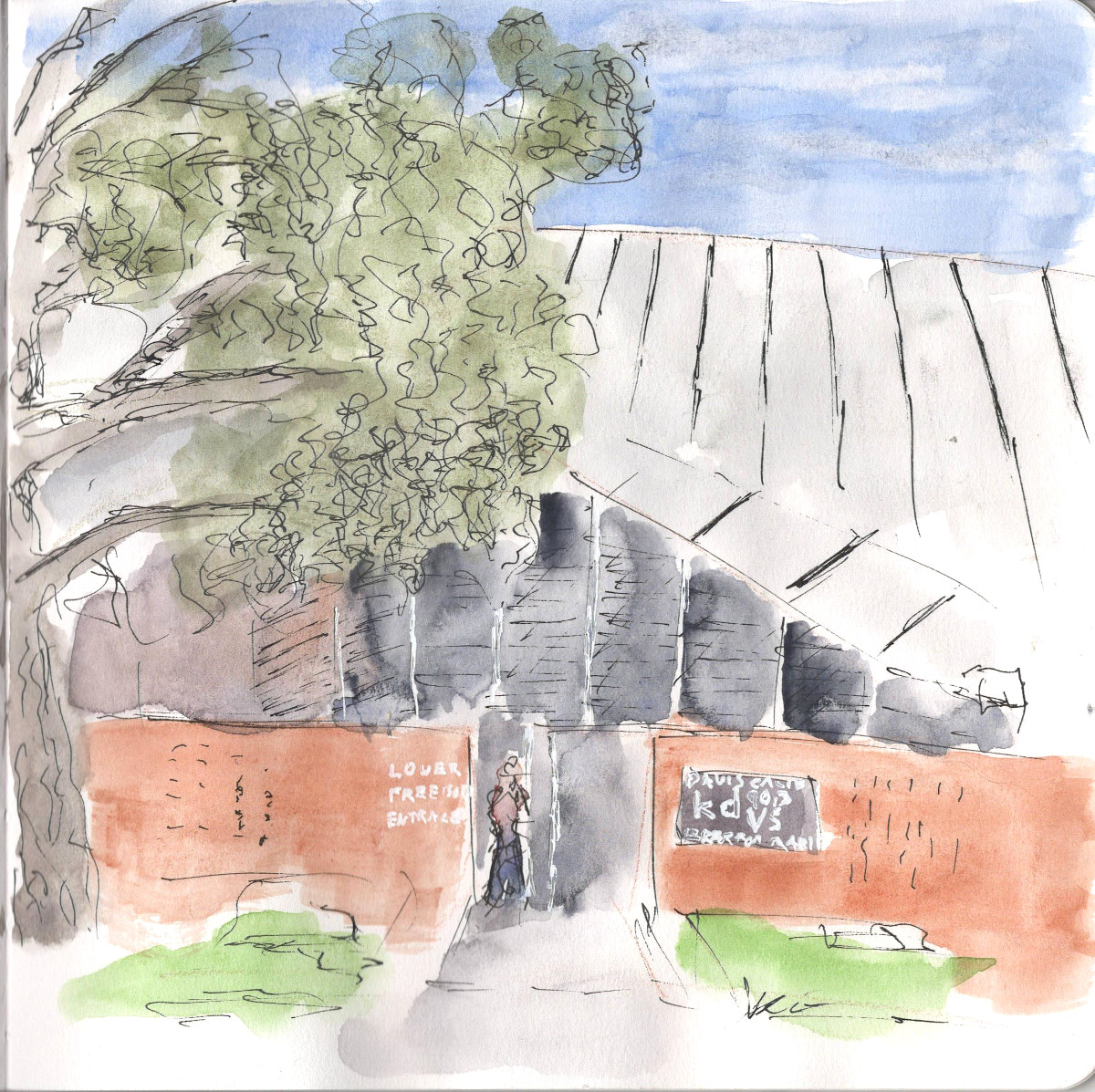 I went over to campus this morning to do my urban sketch for the day and found myself sitting across from the entrance to the KDVS studio in Freeborn Hall. KDVS is the college radio station here, broadcasting at a power of 13,000 watts from an 194’ tall antenna located near the Yolo County Landfill northeast of Davis. Their tagline is “Freeform Community Radio”, which is par for the course for a college radio station.
11 September 26
Watercolor for Haters
 I have a definite comfort zone when it comes to sketching: I sketch in fountain pen with waterproof ink, then I add watercolor. But I’m not a watercolor artist. It’s a fiendishly difficult medium and I have a tremendous amount of admiration for people who do it well.
Tomorrow I’m taking a class called Watercolor for Haters. I am looking forward to fun and sloshing water and paint around. I can’t wait.
3 September 26
Catalunya in German
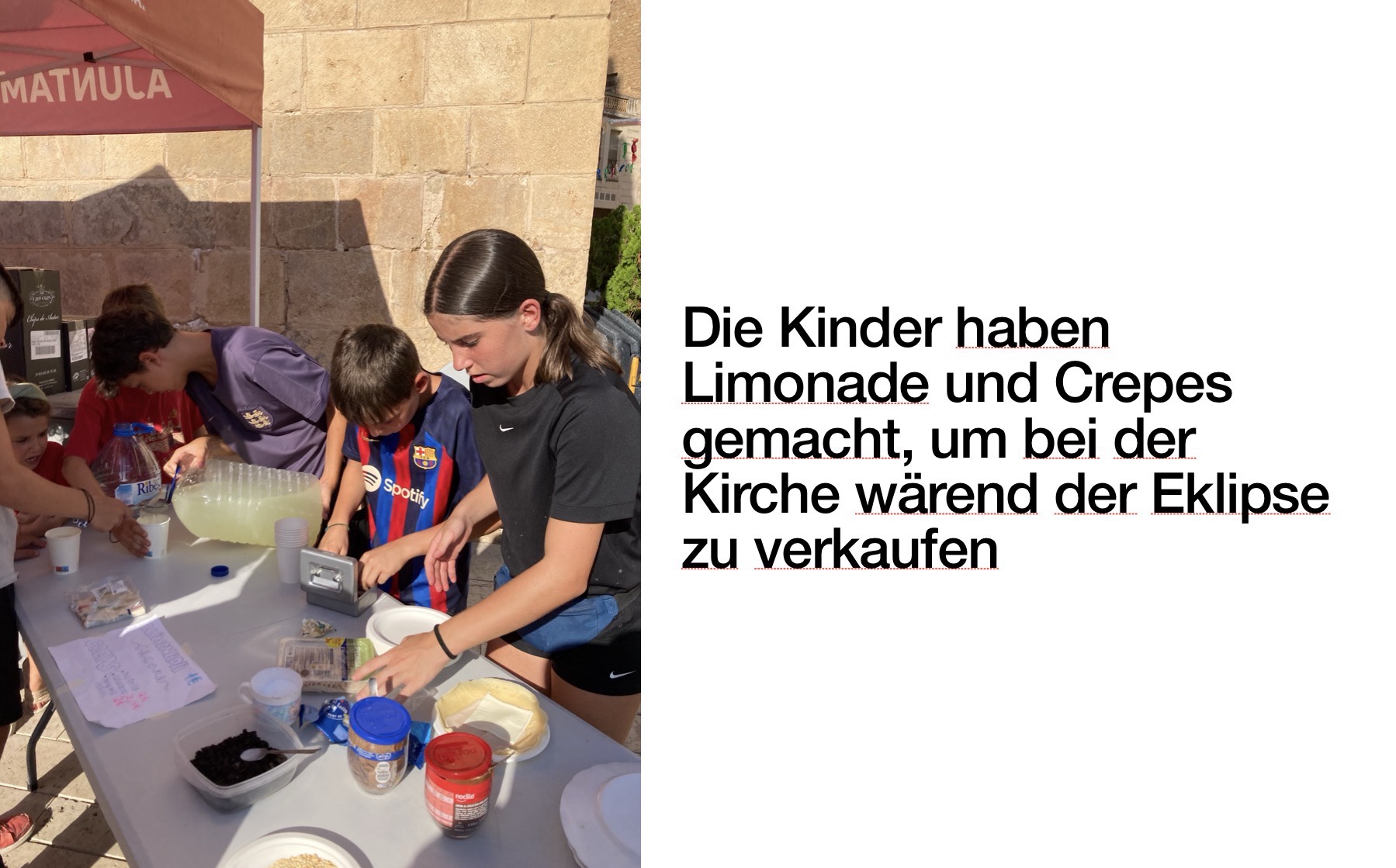 We took the month off in our German class (this is a weekly Zoom meeting through International House which I’ve been running since our teacher Paul died a couple of years ago). I was asked to make a presentation on our Catalunya trip (this isn’t unusual; folks often share their photos from trips). I hurried to put one together.
I often tell people I don’t take photos on vacation, I sketch. But this is patently false, since I managed to find a whole load of pictures I took with my phone (sometimes to provide color reference for sketches I’ve made in ink but not yet painted in watercolor). It was fun to combine photos with sketches. The kids in this photo were football pals who had made 20 litres of lemonade (well, Ruth did) and crepes, which they sold for one Euro each in the plaza outside the village church and made a killing.
The difficulty comes in switching registers from Catalan to German. (I’ve made at least one German error in the caption to this photo: according to the acronym TEKAMOLO (temporal/causal/modal/local) which is used to remind students how to order German syntax, the “bei der Kirche” should come after “wärend der Eklipse.”) It was even harder on the day of the eclipse, when I was out and about sketching, running into a young French artist who had made it to Tivissa by train and hitchhiking. My French is, or was, good, but I found myself inserting Catalan words liberally into my French sentences…
2 September 26
Sometimes A Trap
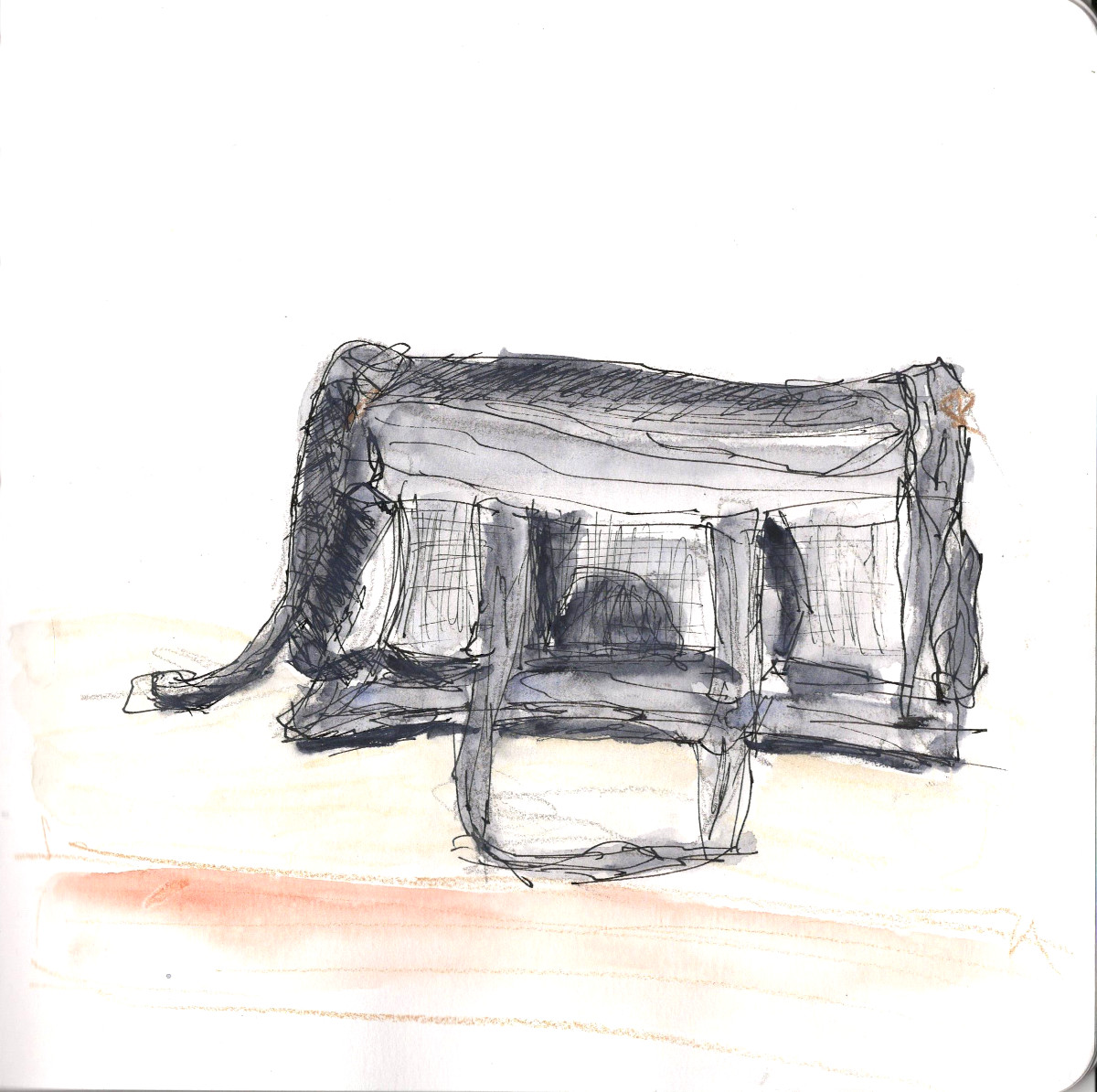 My sketch for today is of one of our cat carriers. Our cat Winston had his annual checkup and vaccinations today, which mean schlepping him six blocks to our vet. It was no challenge getting him in the cat carrier. Quite the opposite. He hopped into it to check it out about 25 minutes before departure time, and promptly started dozing. Alas for him, the time came to leave, the top got zipped up, and he was no longer free. But he had a brief and good appointment, and we quickly got him back home.
30 August 26
A Crisis With the Kit
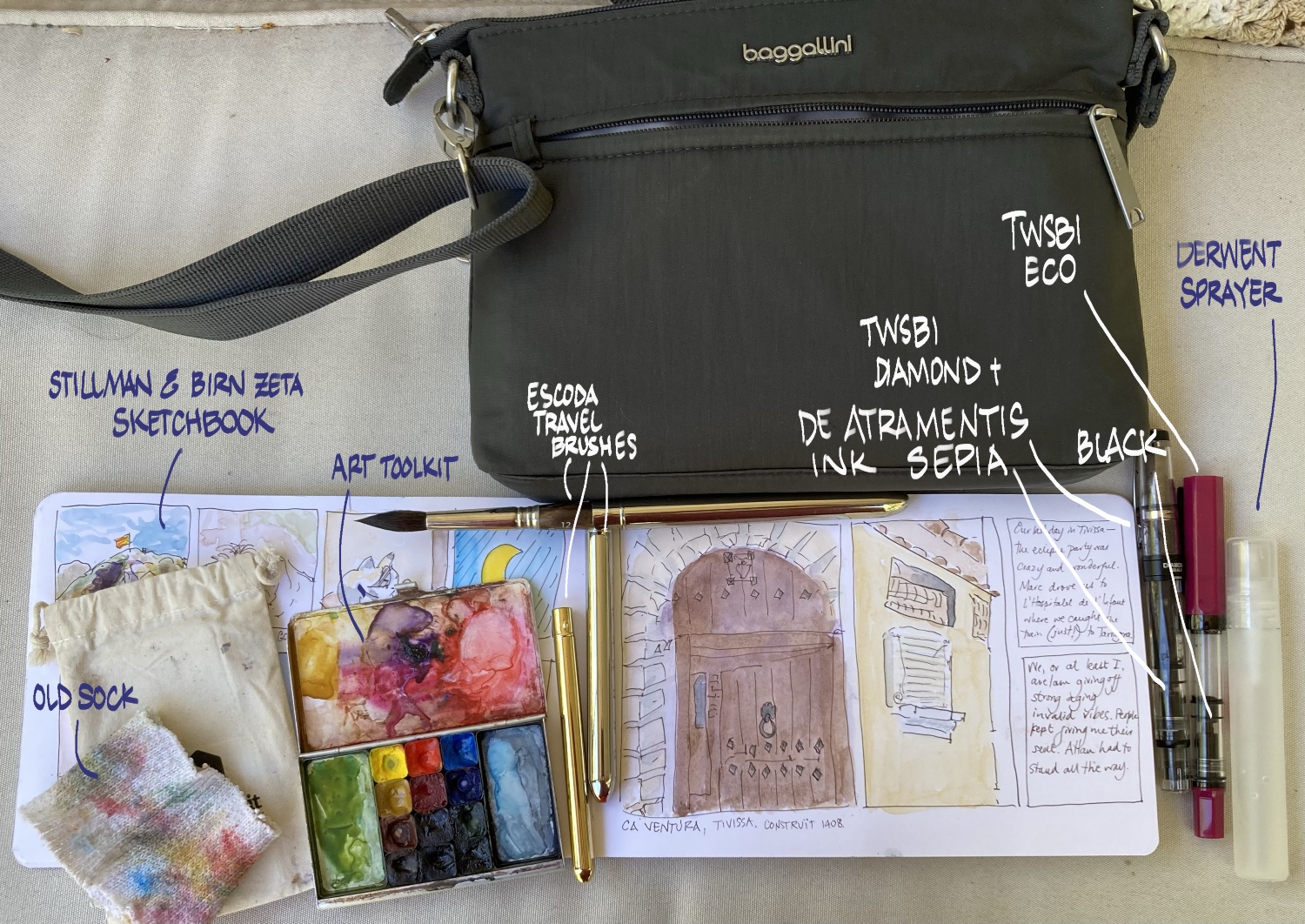 One of the hardest things about packing for a trip is to determine how little you can get away with in the article of art supplies. Both Numenius and I like to sketch in place, with the occasional drawing done after the fact from a photo. This means being nimble — your sketching stuff should be easy to pack and retrieve, light, and as comprehensive as possible.
Although fountain pens in planes can sometimes be disastrous, I’ve found the TWSBI brand loaded with DeAtramentis Document Ink to be very reliable. I like this ink because it’s waterproof: you can sketch in ink then lay in a watercolor wash over the drawing without having it run. The TWSBI Eco has a very large reservoir for ink which lasts a long time.
Unfortunately the TWSBI Diamond isn’t as large and though the nib is delicious on the paper I chose for this trip — Stillman and Birn Zeta — I managed to run out of ink in Tarragona before the trip was over. I’d been using a brown-black (“Sepia”) ink which is new to me from DeAtramentis. I still had a TWSBI Eco loaded with what I thought was Urban Gray, but which turned out to be black, which suddenly felt very harsh. (Stressing out about this kind of thing definitely falls under the category of First World Problems, of interest to maybe three people, but still.)
My attempt to remedy my predicament had us visit “the largest stationery store in Europe,” Raima, in Barcelona. I didn’t find ink there but I picked up a permanent brown marker. This turned out to be too light. We did find a nearby pen store that stocked ink (Platinum, also permanent for fountain pens), but there wasn’t the right brown, and did I really want to buy a whole bottle of ink before I got on a plane? I decided against it. Numenius lent me a Uniball Signo brown-black pen for the rest of the trip which was definitely close in color to what I wanted but I really do prefer to sketch in fountain pen… When we got home I gave my pens a new supply of ink.
You always learn something for the next trip. My favorite place to buy stationery supplies, on this continent, is JetPens, at least where fountain pens and inks are concerned. ETA: forgot to add a link to Art Toolkit which is a fantastic source for pocket-sized travel palettes. I also forgot to add the two waterbrushes I travel with (Pentel Aquash) and a mechanical pencil, which I almost never use.
23 August 26
La Vall de Boí
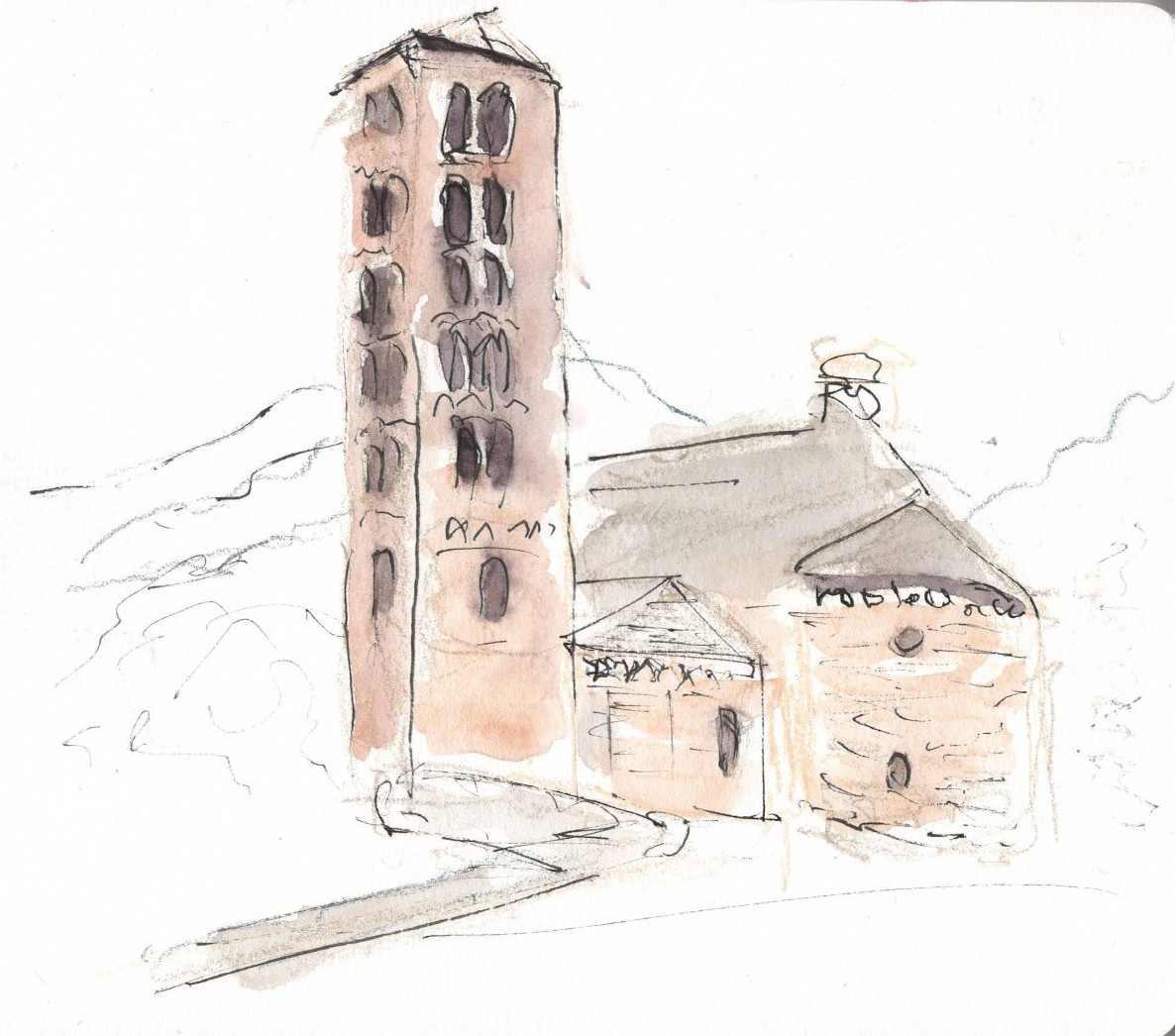 On Sunday two weeks ago we went on an excursion with Jennifer and Harald north into the Pyrenees, Harald having rented a car for the day trip. Our destination was the Vall de Boí, which is a steep-sided valley that is noted for its concentration of Early Romanesque churches: there are nine of these in total in the valley, and the location has been designated a UNESCO World Heritage Site.
I first heard about the Vall de Boí in a two part episode of El Foraster, a series which proves to be a good guide to finding interesting villages to visit in Catalunya. We went inside two of the churches. The first of these was the church Santa Eulàlia d’Erill la Vall, which is next to the visitors’ center for the site. I went all the way up the six stories of its bell tower. The second church, a bit farther up the valley, was Sant Climent de Taüll which is the largest and best preserved of the churches in the valley. At left is a sketch of the church viewed from the south.
22 August 26
Lleida
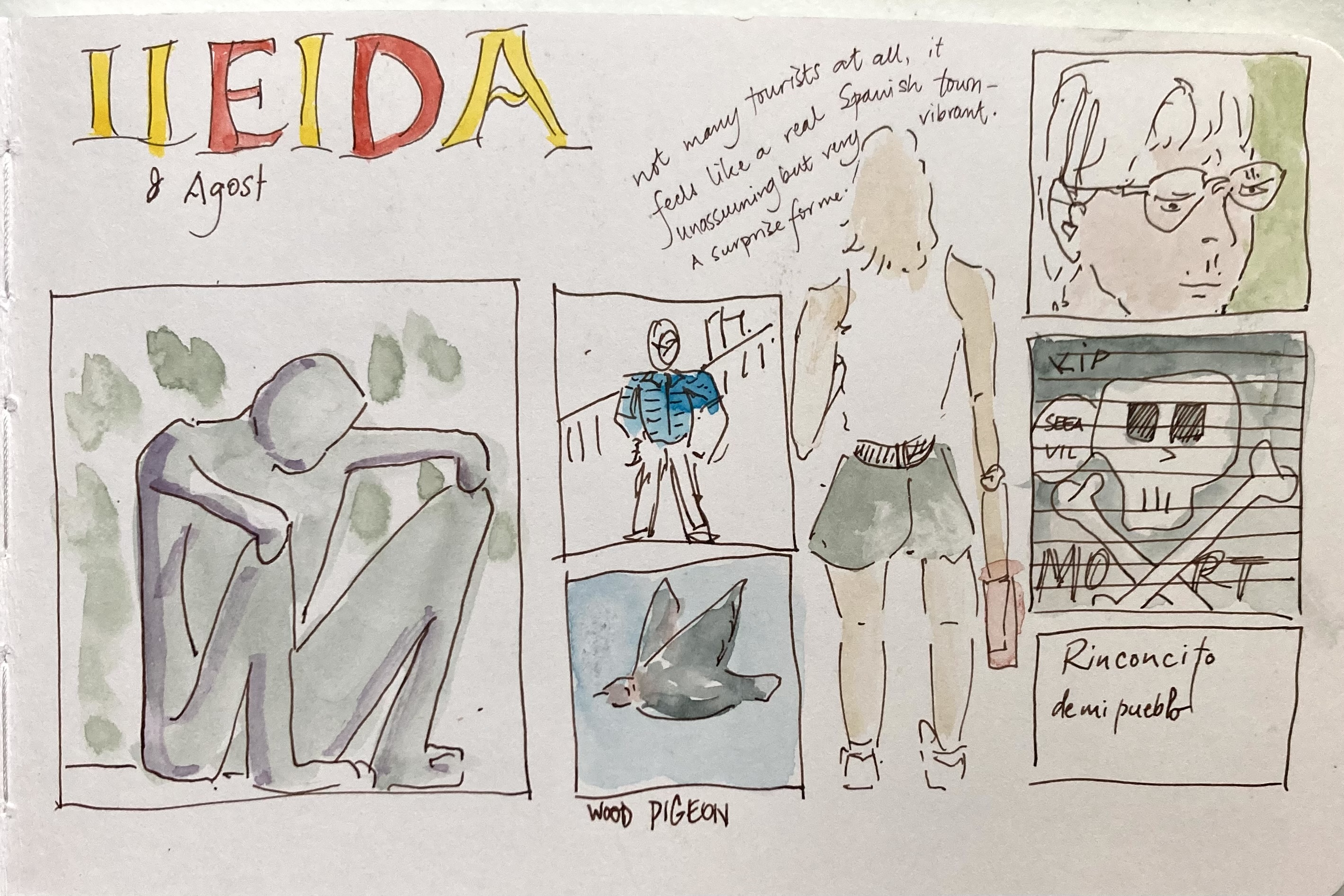 We moved from Girona to Lleida, which is in the western part of Catalunya close to the Pyrenees. We’d had a very positive review of this unassuming city from our friends in Girona, and approaching the city on the train moving through orchards, with a strong Central Valley vibe, we felt very at home.
What I really noticed almost as soon as we arrived was how real the city seemed. Very few tourists — we really stood out — and the lift to the upper levels of the city was being used for inhabitants to navigate their daily lives, rather than for tourists to get up to the cathedral. The city was besieged and bombed heavily in the civil war (1936-39) with the result that the post-war buildings spread out around the central hill and into the ag lands beyond.
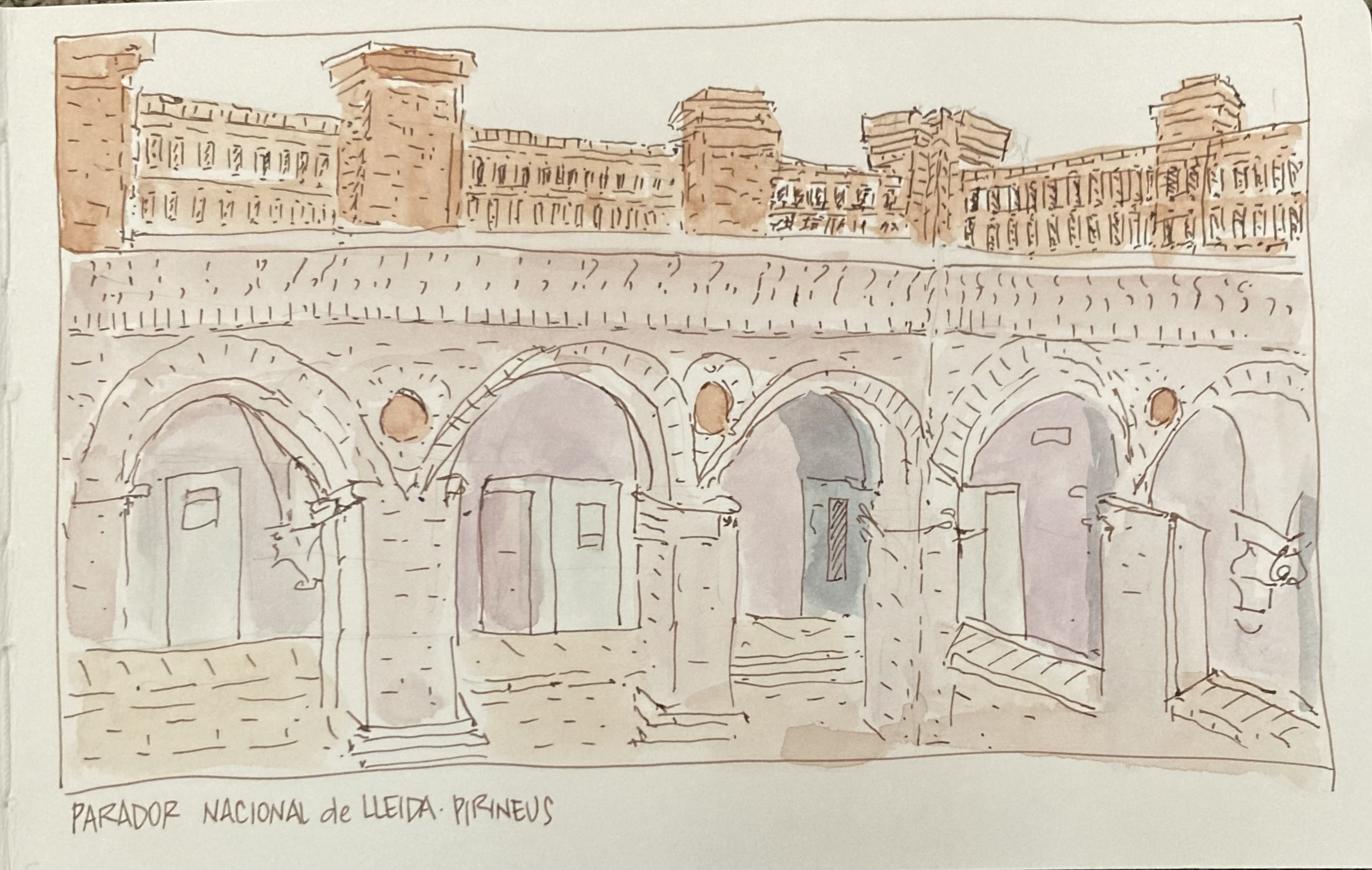
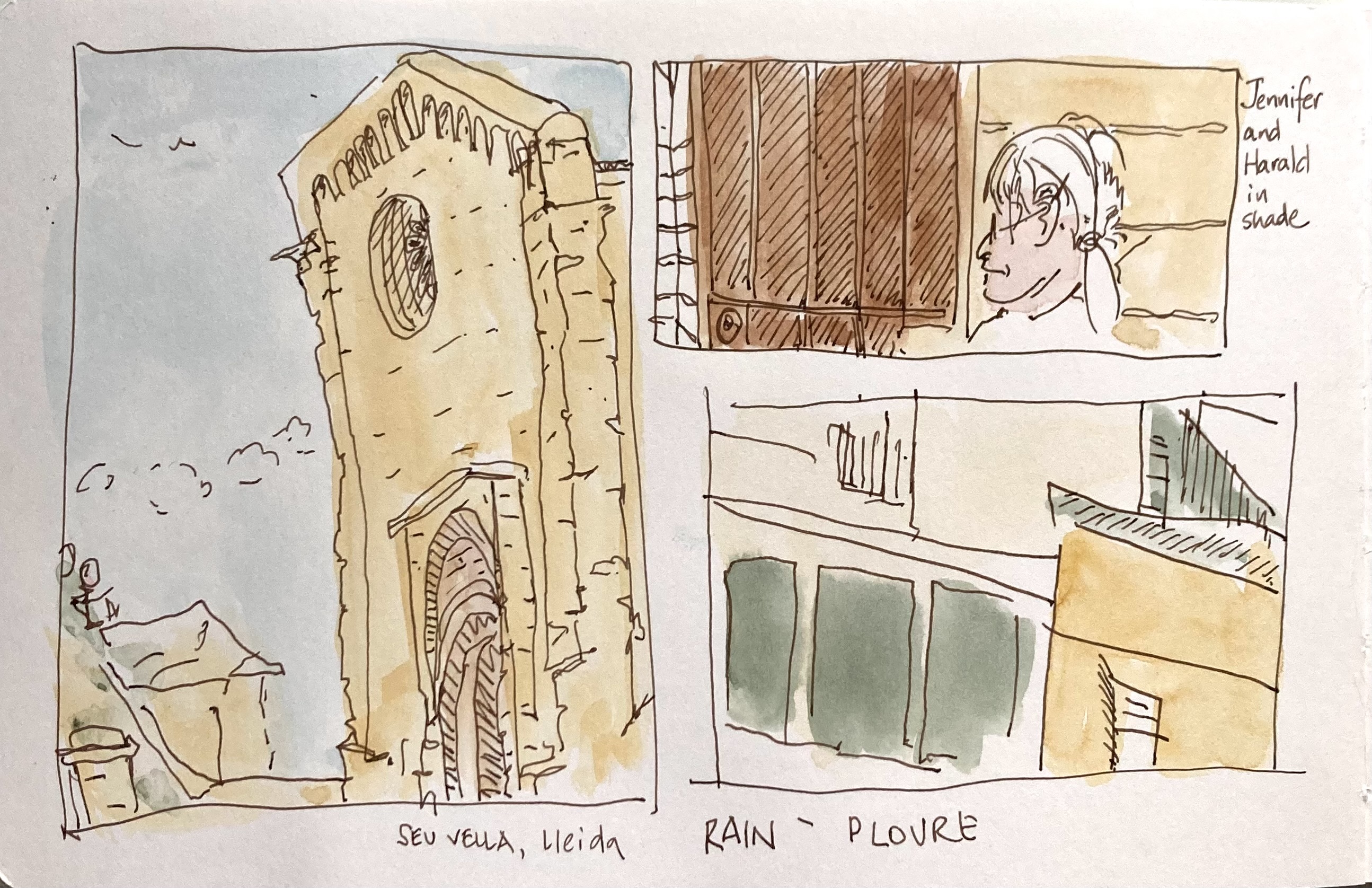 We met some friends in Lleida who live in Sweden but with whom I’d grown up in Madrid. We stayed in a parador, which was a converted convent in the upper level of the town. It was a spectacular setting and for Jennifer and myself a sweetly nostalgic experience. (Jennifer and Harald were given a room with a kettle and we weren’t, with the result that she snuck upstairs in her pyjamas leaving me a thermos of tea outside the door, which was very gratefully received.)