
7 June 26
For Lease
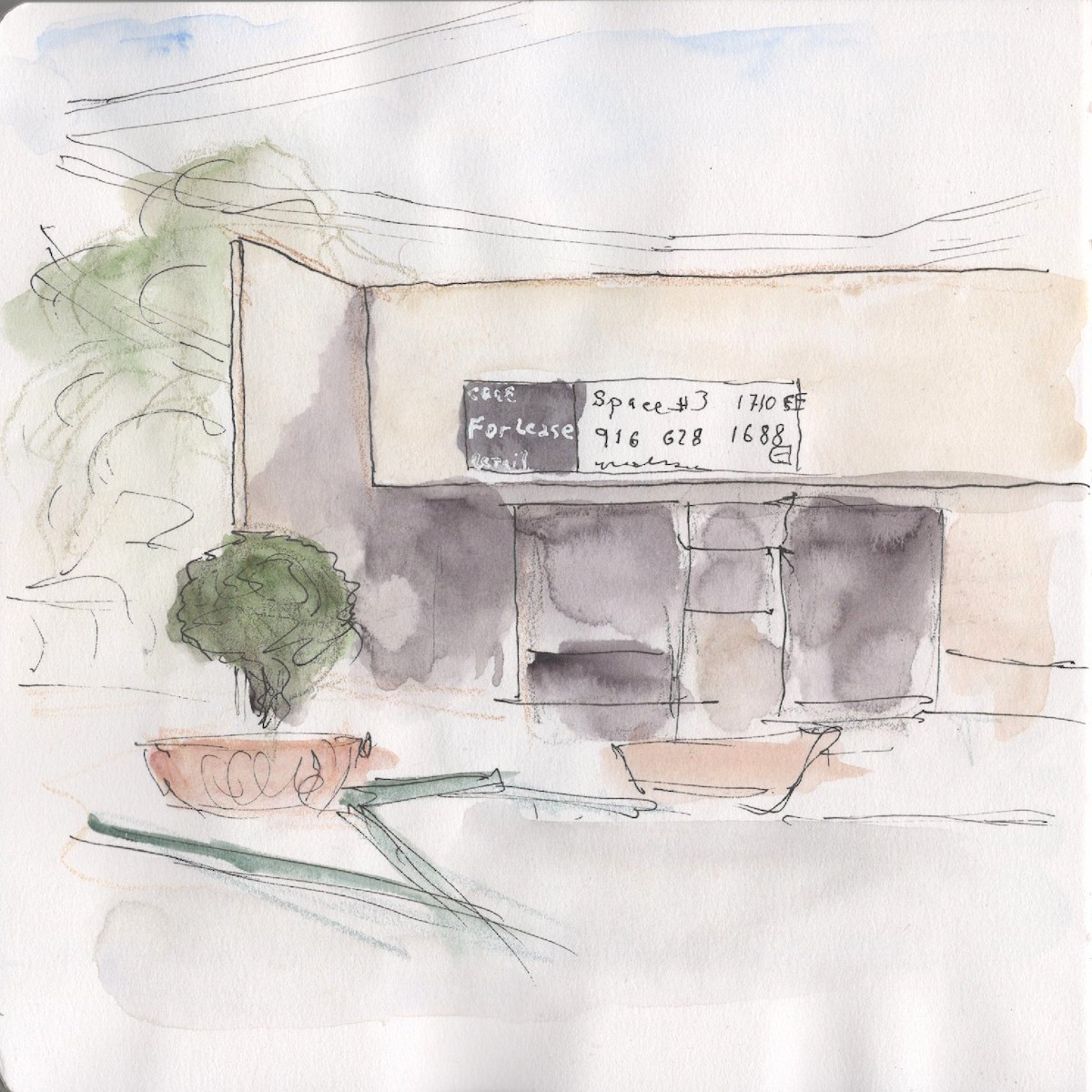 Here is yesterday’s urban sketch. This is the northernmost corner of the retail mall on G Street north of the Davis Food Co-op. Three of the nine spaces in this mall are vacant, though it does contain a good bike store and our favorite local bakery.
30 May 26
Radical Cartography
One of my habits is stopping by the public library briefly and seeing what is on their new book shelf. This past Tuesday I found a copy of William Rankin’s new book Radical Cartography: How Changing Our Maps Can Change Our World and didn’t hesitate to check it out. Bill Rankin is a historian of technology and the geographical sciences at Yale University. He has been experimenting with cartographic techniques for a couple of decades now and has kept up a library of his projects at the site radicalcartography.net.
To Rankin radical cartography is not so much about the politics of the theme, but rather getting away from the conventions of mainstream cartography with its emphasis on neutrality, deference to data, and aspirations towards a single interpretation. Instead he proposes fostering the values of uncertainty, subjectivity, and multiplicity.
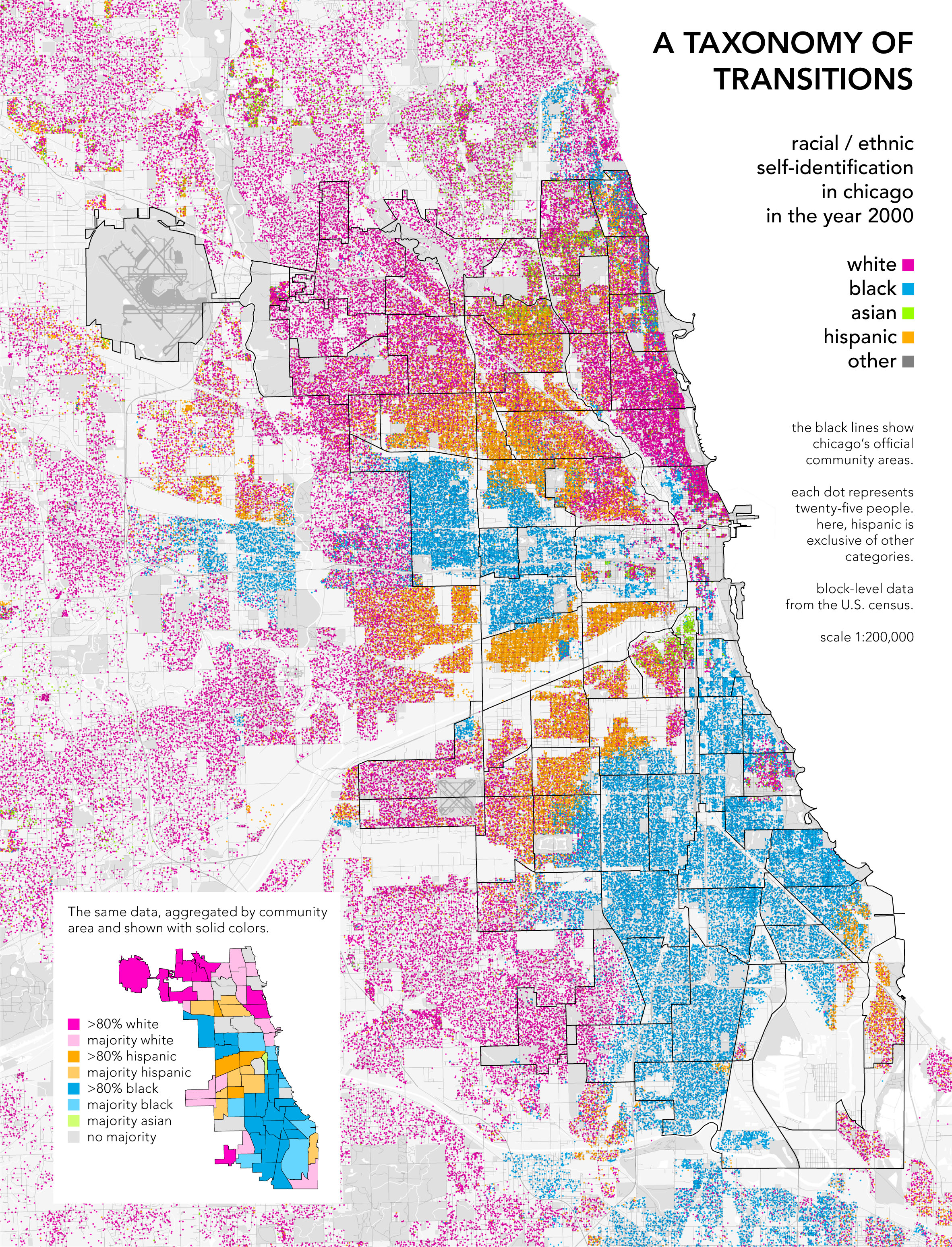
An example of this is Rankin’s work on mapping ethnic self-identification in Chicago. There is a long history of mapping ethnic neighborhoods in Chicago dating back to the 1920s. The maps of these patterns got reified into community areas which became the way Chicago understands its own geography. Rankin’s map illustrates that the transitions between many of these community areas are a lot more gradual than the “jigsaw puzzle” mapping of the areas would suggest. His technique in this map is to do fine-scale dot mapping: each colored dot represents 25 people of a particular ethnicity. This contrasts with shading the entirety of the community area with a color representing the majority ethnicity.
The book is organized by seven different elements of cartography: boundaries, layers, people, projections, color, scale, and time. As somebody who has done a fair amount of cartography professionally, I learned interesting concepts in all seven of the sections. Some of Rankin’s approaches run against my instincts, but that is part of his message, and there are techniques I’d like to experiment with. I’d definitely recommend the book for map lovers and geography students.
28 May 26
Feral Potato
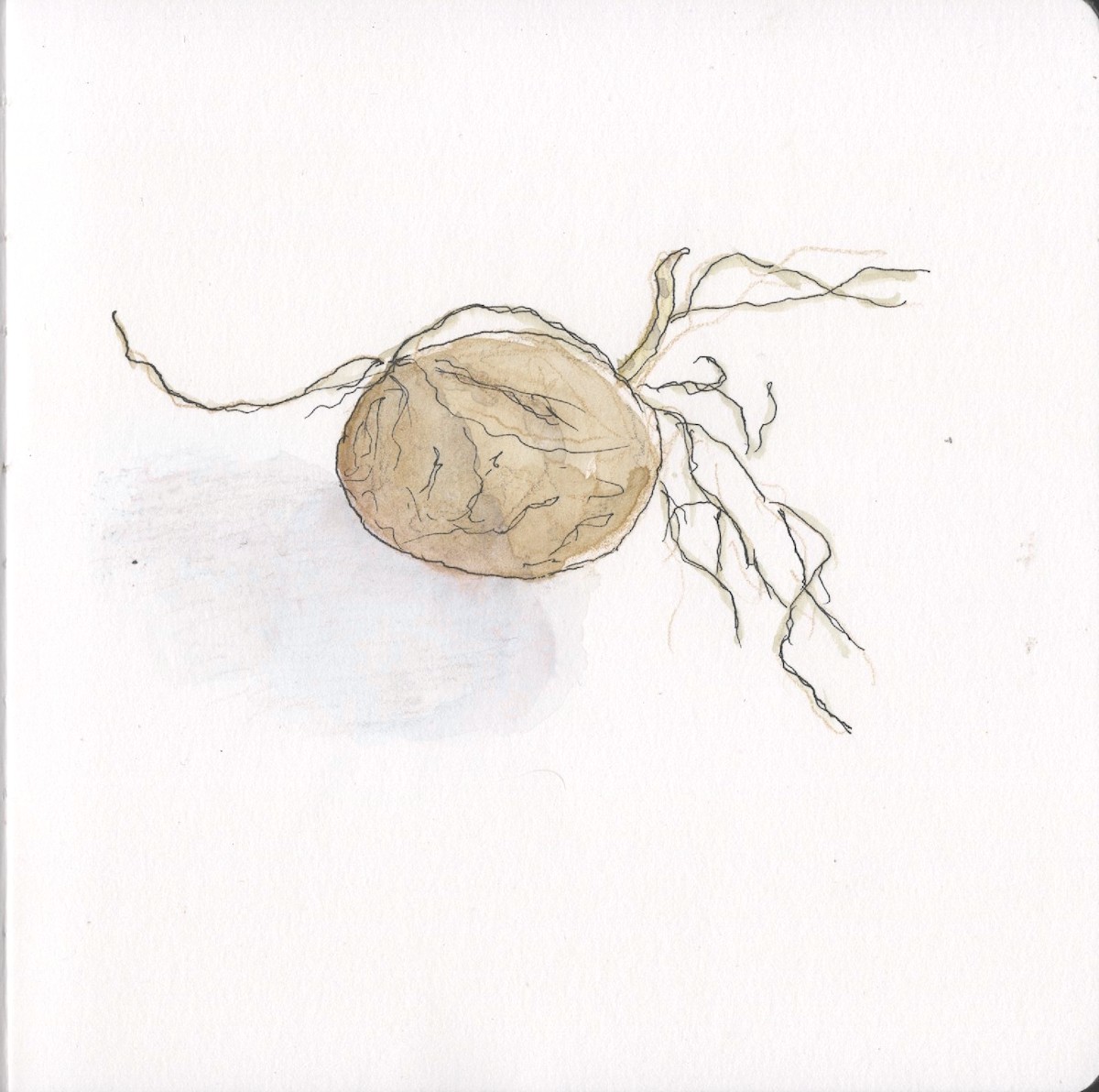 As Pica mentioned yesterday, she unearthed some volunteer potatoes growing from soup leavings used as compost for one of the flower beds. Here is a sketch of one of them.
Lately I have been using black ink in my pen and wash sketches — for some reason I want strong contrast in my linework right now. This is sketched with De Atramentis black ink in a medium Pilot Metropolitan fountain pen.
24 May 26
Craft Fair
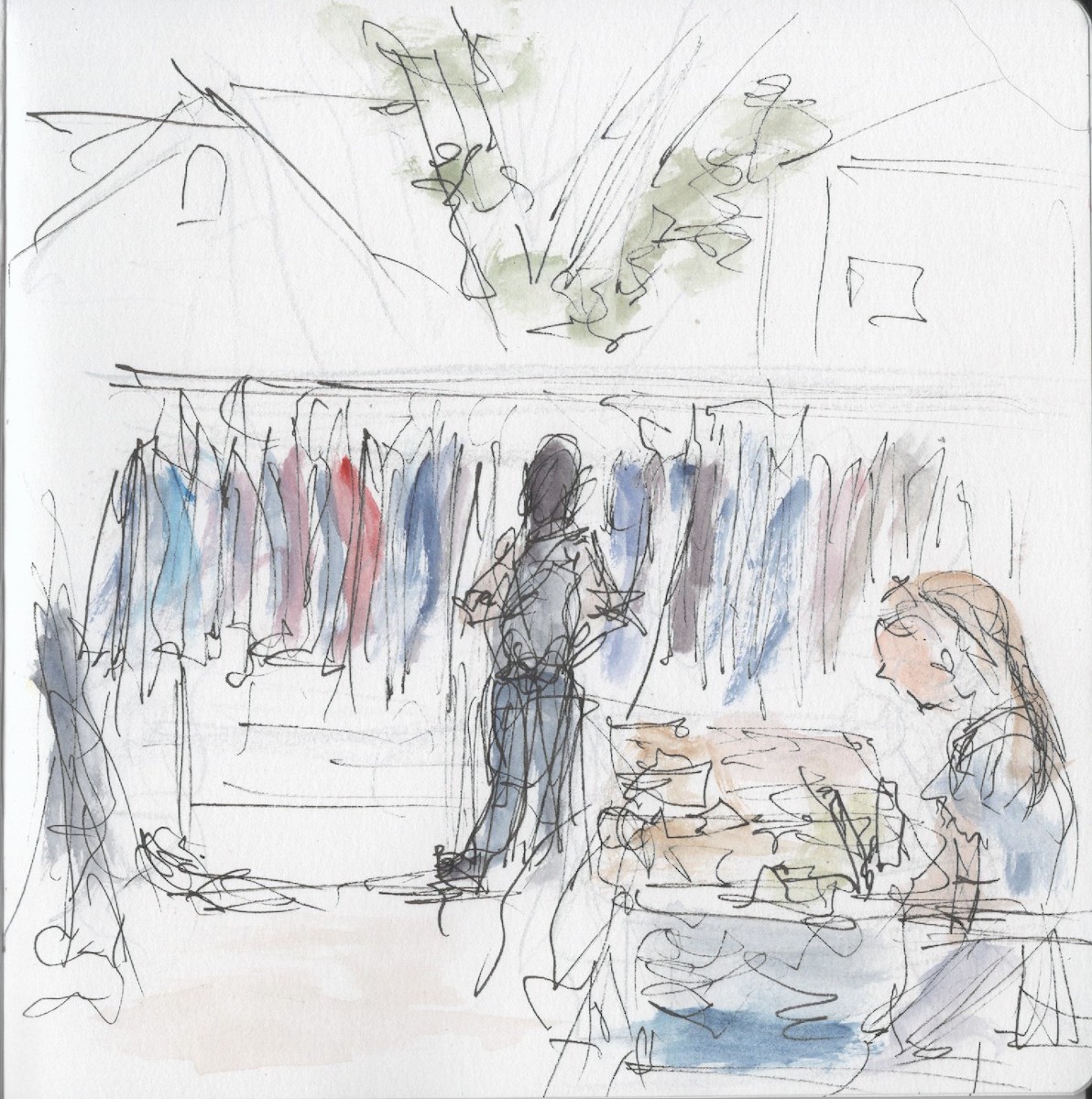 On Sundays twice a month the Davis Craft and Vintage Fair takes place in Central Park. It is pleasant to wander through, and there is almost always live music at one end of the concourse. Here is a sketch from today of one of the stalls.
22 May 26
Drying Days
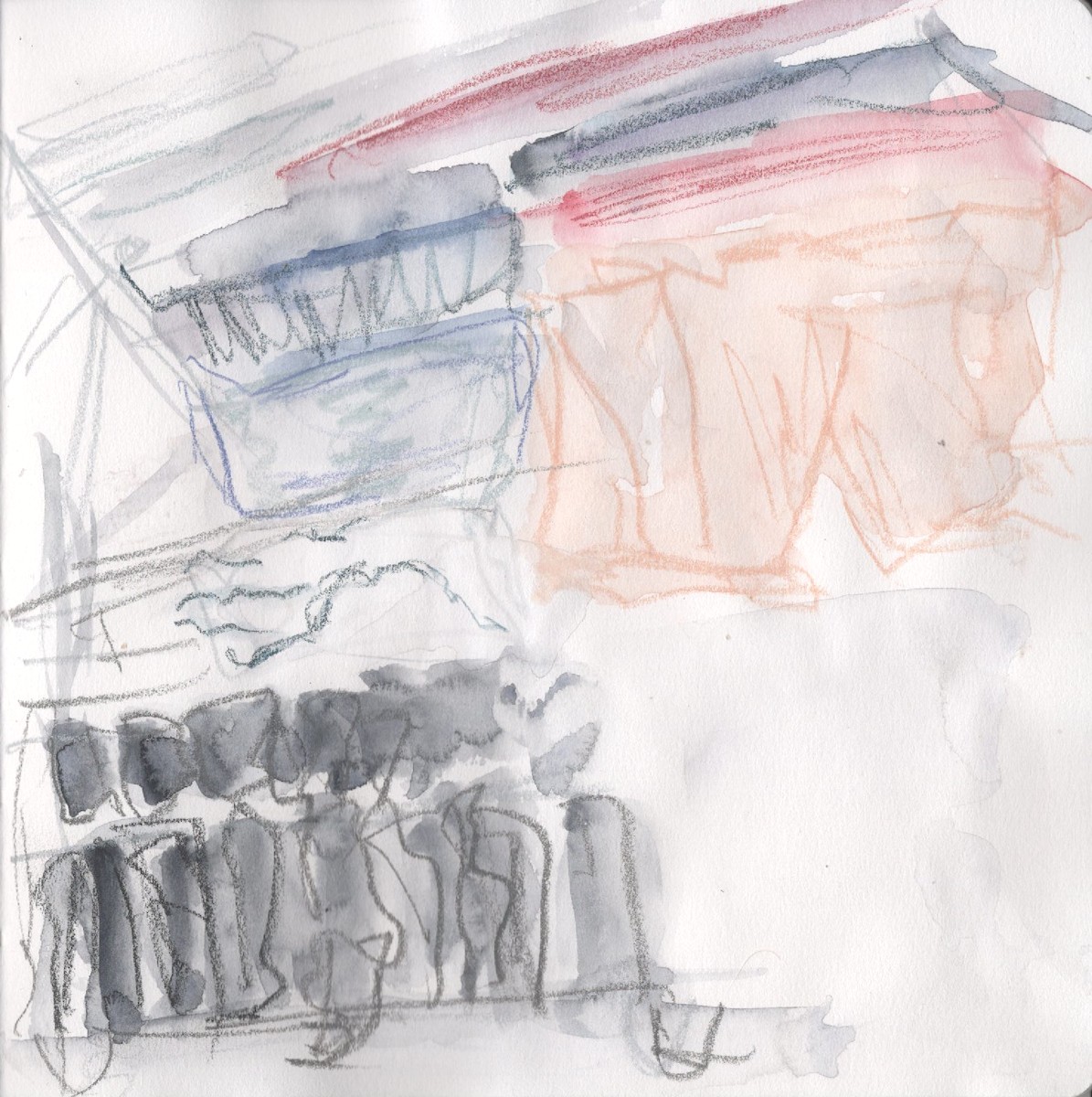 It reached 95° F today with 26% relative humidity. These are good drying days. But if you are neither a) drying your clothes on a line outside or b) a watercolorist this may be an unfamiliar concept. How rapidly do wet materials dry given the present combination of relative humidity and wind speed? It doesn’t seem to feature in weather websites in the United States, though I did a Kagi search on “drying days” and came up with a laundry drying guide for London. Today’s weather there was rated “Superb”.
I am now trying sketching experiments with layers where I am painting first with loose watercolors, and then drawing over the watercolor with my Derwent drawing pencils. This calls for good drying days, since the paper needs to be perfectly dry before drawing on it. Here is a sketch I did earlier today in this manner of our laundry on the drying rack.
16 May 26
Sketchcrawl With Waffles
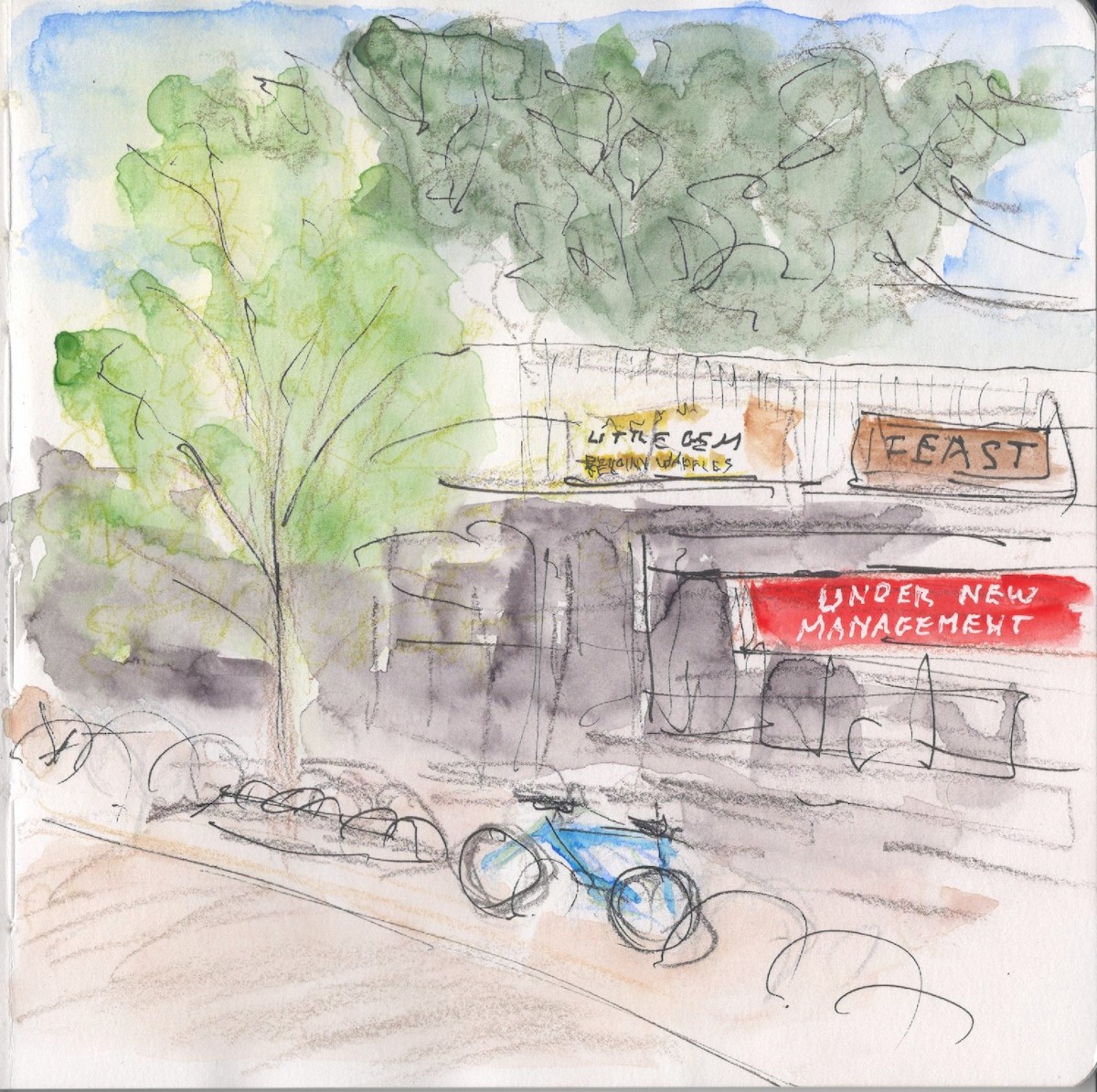 As Pica related previously today we had a sketchcrawl meeting at 3rd and A Street in Davis. Pete Scully who organized the sketchcrawl said he likes sketching along A Street since it marks the border between campus and there is a lot of interesting activity at this boundary. He also remarked upon the arrival of the Little Gem Belgian Waffles shop; he quite liked the one in Berkeley but hadn’t eaten in this one yet.
I sketched the restaurant from the other side of 3rd Street and then crossed over A Street into campus to sketch the Social Sciences and Humanities Building aka The Death Star. Pica meanwhile tried one of the waffles and found it yummy.
15 May 26
Sketchcrawl Tomorrow
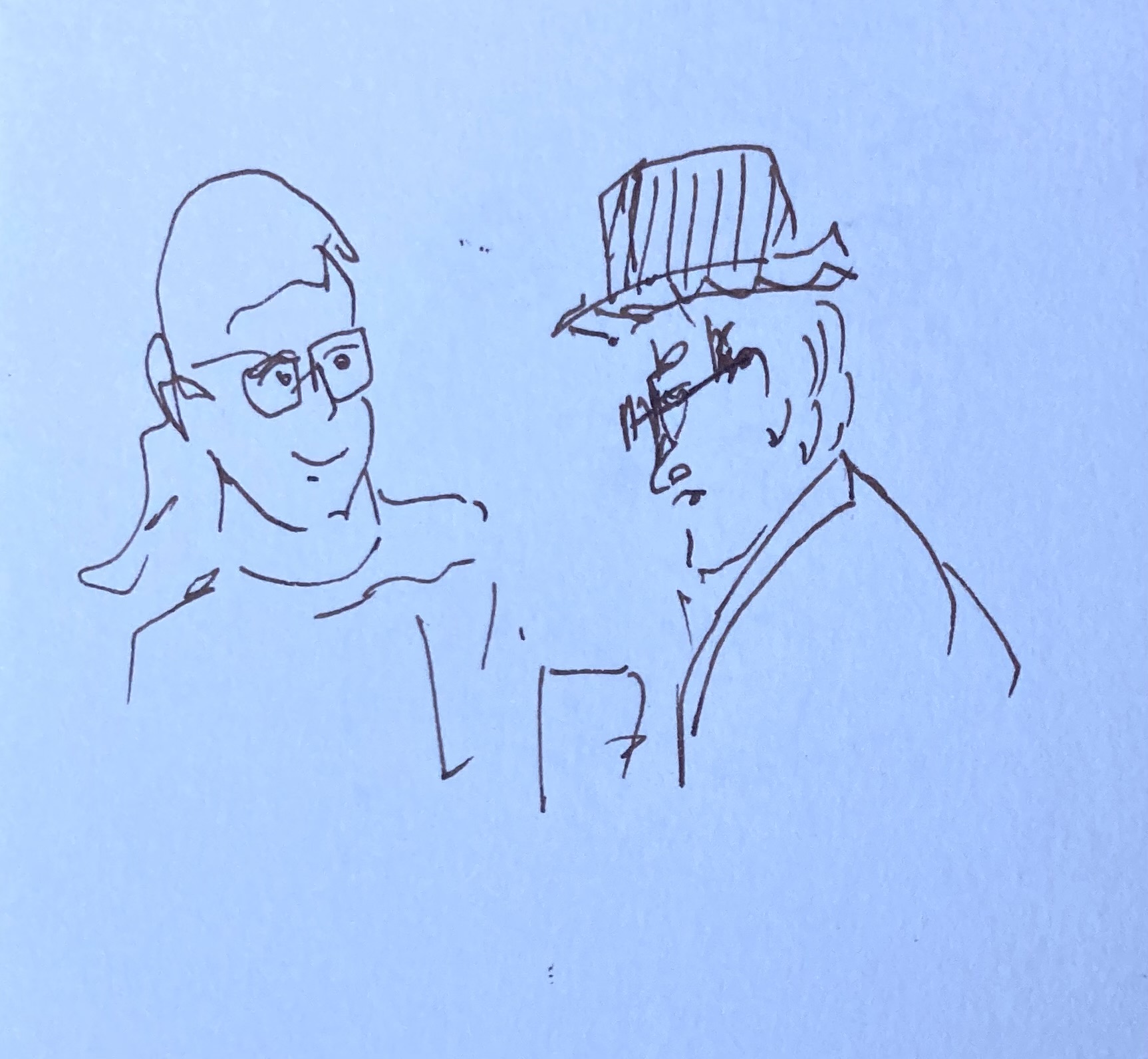 The Let’s Draw Davis urban sketchers has been for over 20 years (not sure exactly, but we participated in the very first one along with one other person, Pete Scully, who is now a personage on the worldwide urban sketchers scene).
I always mean to draw things other than people during these sketchcrawls, but it’s the one time when you can draw your fellow sketchers without getting weird looks (the couple in my drawing figured out I was drawing them and I think it made them uncomfortable, which is sad).
I’m going to take the minimal kit I took with me to Germany: fountain pen and tiny watercolor palette from Art Toolkit.
14 May 26
Hollyhocks
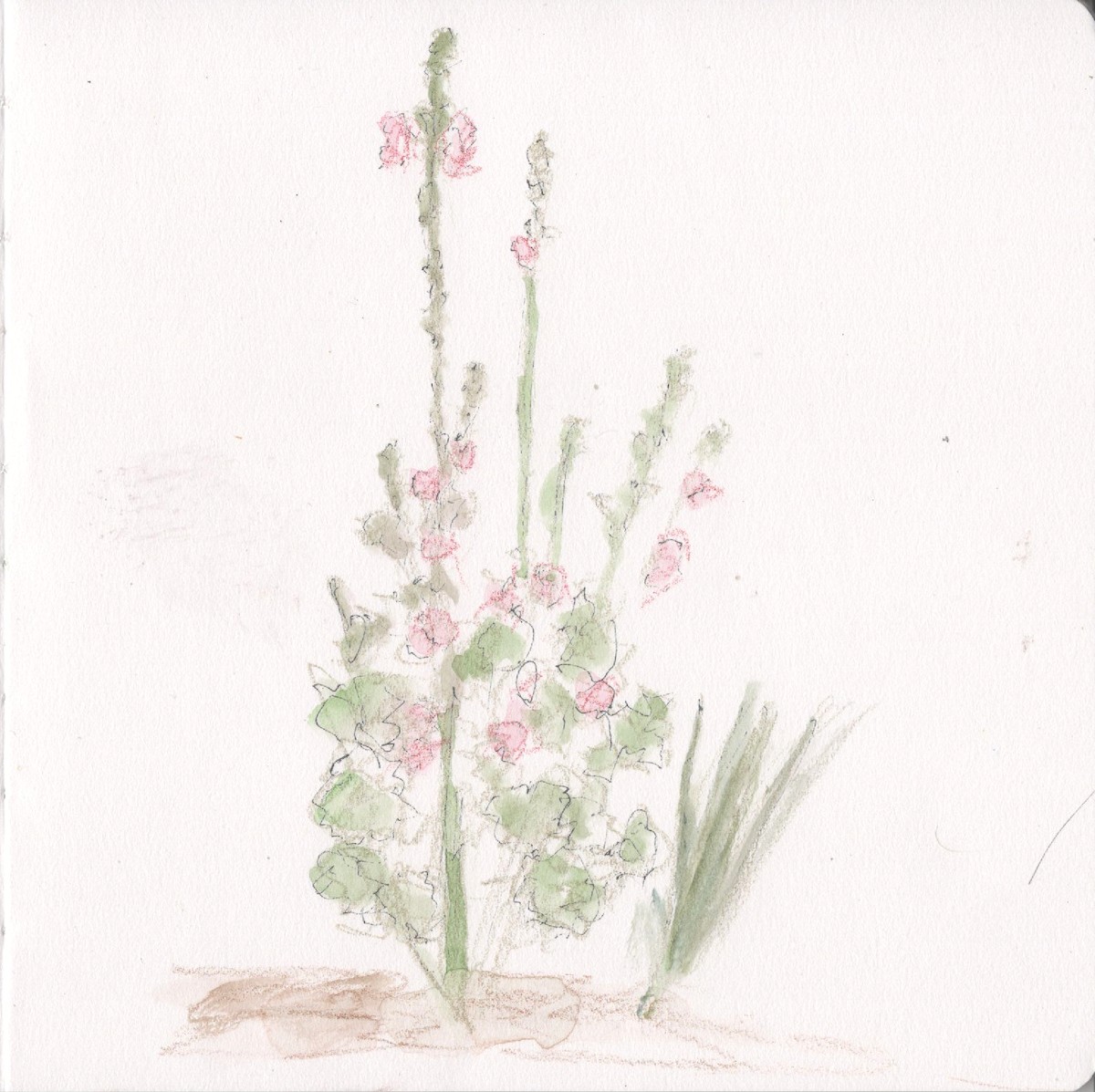 Hollyhocks are in bloom throughout our neighborhood now, including some straggly plants in our backyard. This is a sketch of some hollyhocks growing in a little public garden across the street from our house. This is my second field sketch using my new Folio Palette kit. It’s nice to have lots of colors to choose from between the 26 colors in the filled pans and my expanded colorful set of Derwent drawing pencils.
12 May 26
Folio Palette Is Filled
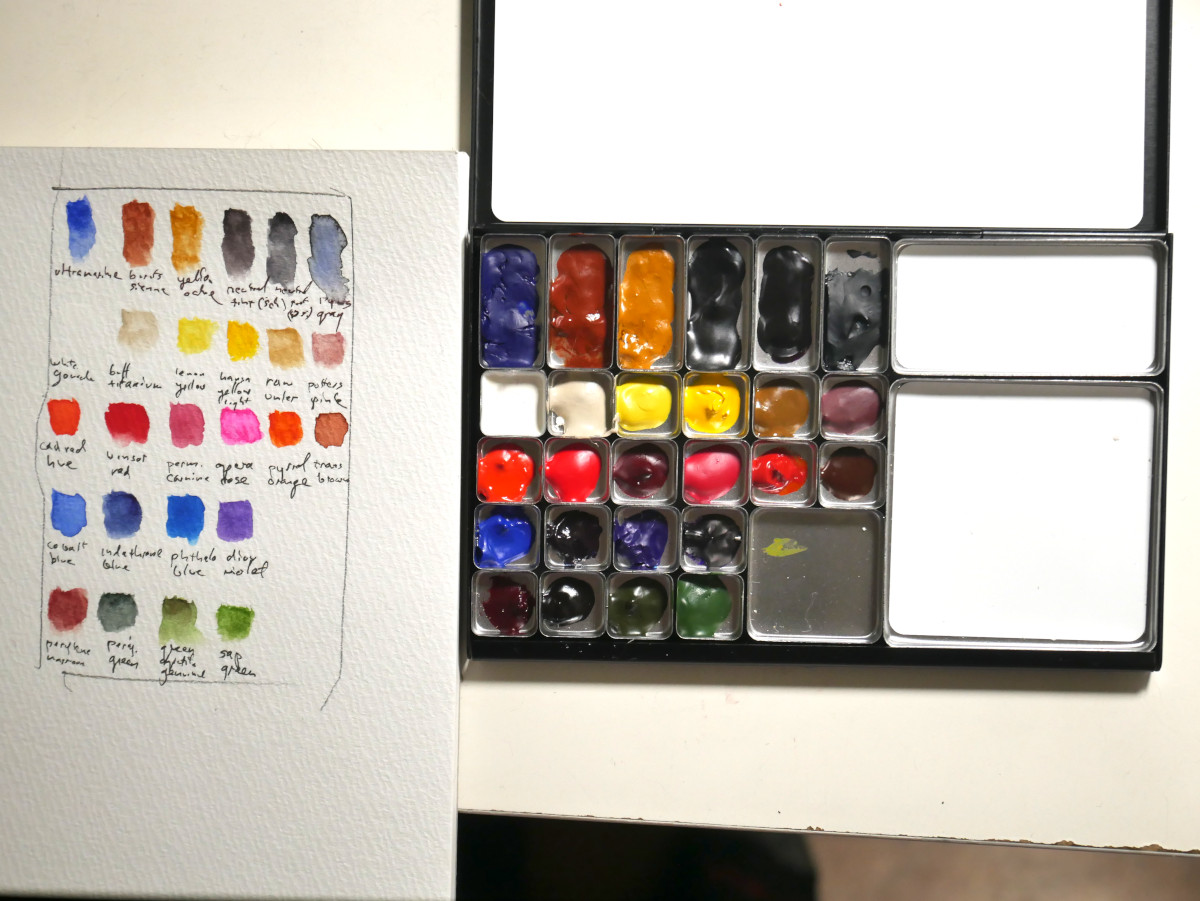 The paints I ordered for my Art Toolkit Folio Palette arrived yesterday and I have filled the palette with the 26 colors I selected. I painted a swatch chart which is to the left of the palette in the photo. I am going to mount the swatch chart on cardstock and carry it around in my art supply pouch with this palette.
The other component to expanding my field kit is adding additional pencils that are in the new Derwent drawing pencil set to make up a field set of pencils. This is a project for tomorrow or the next day.
8 May 26
Whole Earth Day One
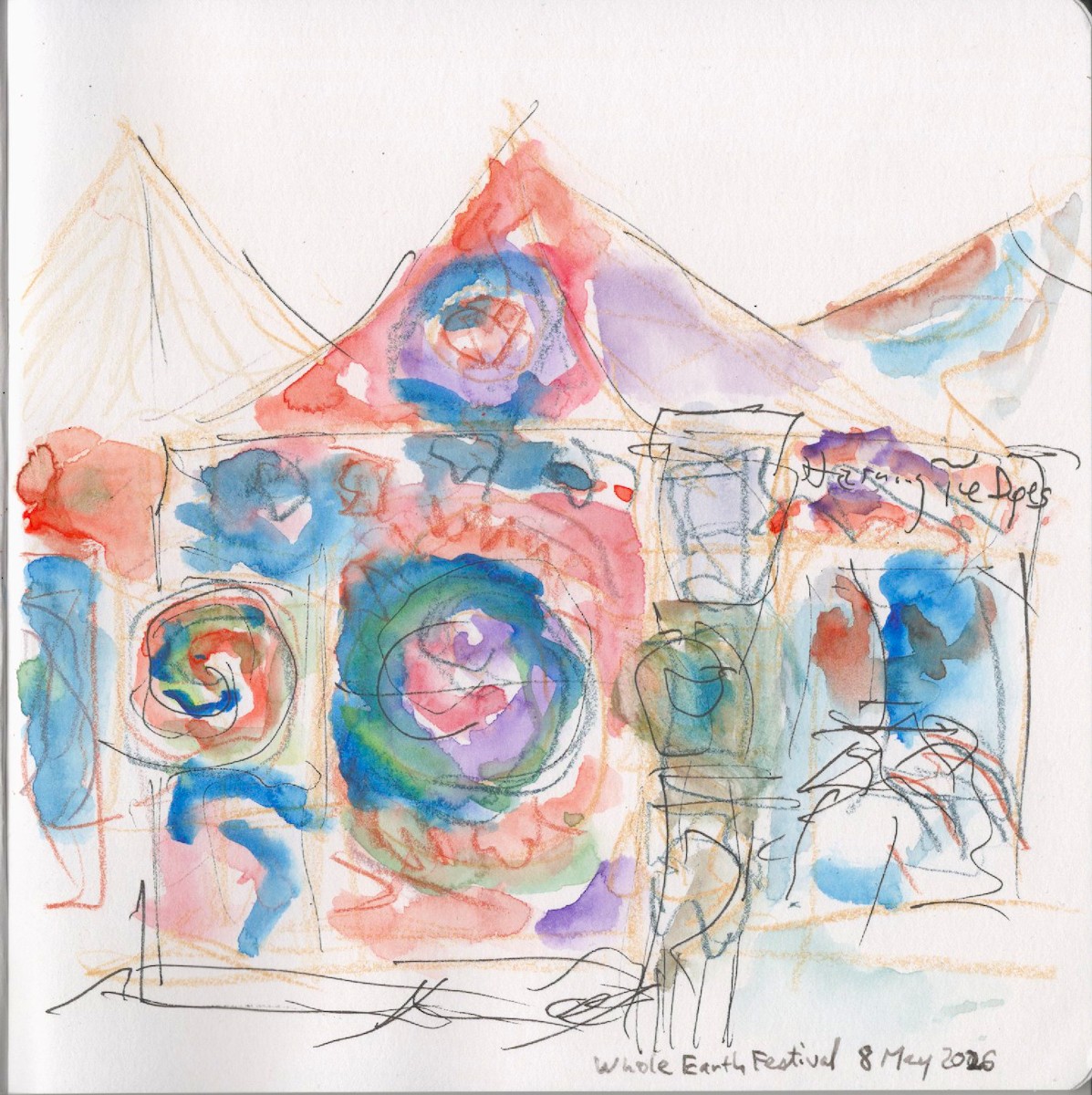 Today was the first day of the Whole Earth Festival, a hippie fest that has been happening at UC Davis almost every year since 1969. The festival runs three days over Mother’s Day weekend. I walked down there late this afternoon to scope the event and perhaps do a sketch. I ended up sketching the outside of this booth displaying wares from the Harmony Tie-Dyes Company.